
The Ministry of Finance has presented its Ministerial Policy Statement for the financial year 2026/27 to Parliament’s Finance Committee, highlighting strong economic growth, falling inflation and expected oil revenues.
The Minister of State for General Duties, Henry Musasizi, appeared before the committee alongside the Under Secretary and Accounting Officer, Dr Sengonzi Damulira, and a technical team to outline the ministry’s plans under Vote 008.
Musasizi told legislators that the economy expanded by 8.5 per cent in the second quarter of the 2025/26 financial year. This was up from 5.4 per cent in the same period the previous year. He said the growth reflects effective economic management and rising demand across sectors.
“This performance reflects effective economic management, supported by strong aggregate demand and sustained investments in productive sectors, particularly ICT, construction, and machinery, which are critical for long-term growth & structural transformation,” said Musasizi.
He also pointed to improvements in price stability. Inflation dropped to 2.9 per cent in February 2026, down from 3.2 per cent in January 2026. Musasizi said this was due to better coordination of fiscal and monetary policy and improved food supply.
The ministry further reported a merchandise trade surplus of $147.26 million in January 2026. This marks a shift from earlier deficits and signals stronger export performance.
On revenue collection, Musasizi said government raised Shs 16,476.07 billion in the second quarter. This was below the target of Shs 17,511.59 billion, giving a performance rate of 94.09 per cent. However, the figure still represents an 8.05 per cent increase compared to the same period in the 2024/25 financial year.
The minister also updated Parliament on progress in the oil sector. He said work on the East African Crude Oil Pipeline (EACOP) has reached 80 per cent. Engineering studies for the refinery are ongoing.
“The Government expects about Shs.2.2 trillion from oil revenues next fiscal year 2026/27, of which Shs.1.4 trillion is programmed to finance the budget,” Musasizi said.
The presentation comes as Parliament reviews government priorities and spending plans for the next financial year.
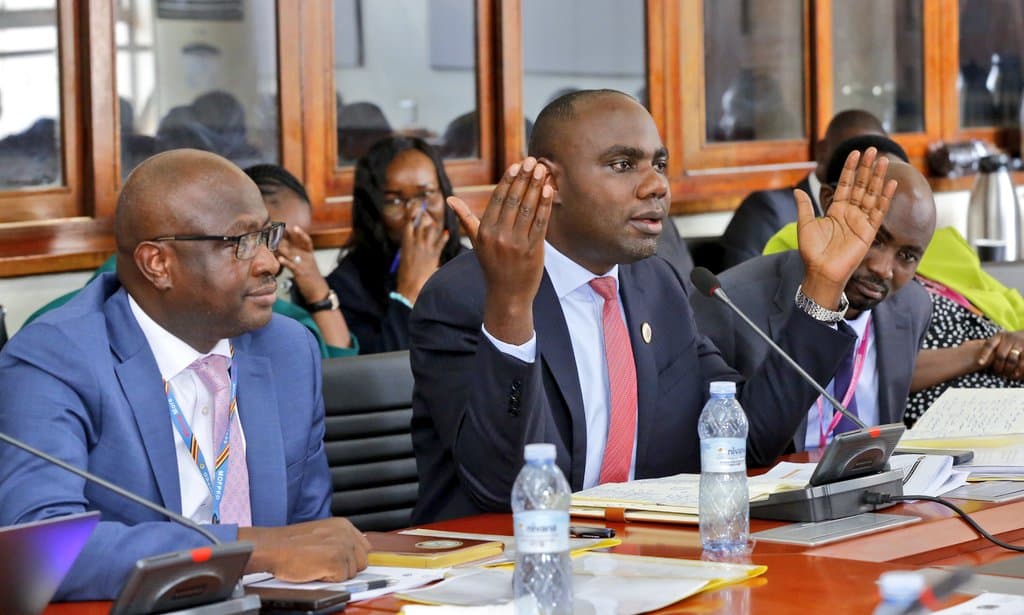
The Minister of State for General Duties, Henry Musasizi, appeared before the committee alongside the Under Secretary and Accounting Officer, Dr Sengonzi Damulira, and a technical team to outline the ministry’s plans
Photo: InternetThe Finance Ministry told Parliament that Uganda’s economy is growing strongly, inflation is falling, and oil revenues are expected to boost the 2026/27 budget.
Advertisement
N
Nicholas Agaba
Author
Topics
Advertisement