Members of Parliament on the Committee on Presidential Affairs have demanded an independent impact evaluation of all public funds and development programs previously directed to the Karamoja sub-region before approving fresh multi-trillion funding requests.
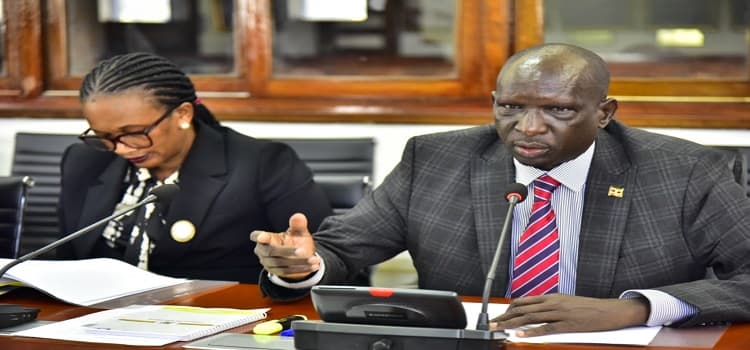
The directive was issued during an interface between the committee, chaired by Hon. Martin Ojara Mapenduzi, and top leadership from the Ministry of Karamoja Affairs, led by substantive Minister Hon. John Baptist Lokii and Minister of State Hon. Esther Anyakun.
The parliamentary session reviewed the proposed Karamoja Regional Development Plan (KRDP)—a 10-year, Shs15 trillion blueprint designed to transition the region from a subsistence nomadic-pastoralist economy into a settled commercial society.
Hon. Lokii presented core infrastructure and economic pillars under the KRDP, which include:
- Constructing a large man-made lake alongside bulk water transfer systems from Lake Bisina for irrigation and livestock production.
- Developing seed multiplication projects, livestock processing zones, and regional industrial parks.
- Expanding school infrastructure, grid electrification, and extending railway connectivity to the sub-region.
However, lawmakers pushed back, pointing out that decades of special interventions have been undermined by duplication, ghost projects, and a lack of accountability.
Amuru District Woman Representative, Hon. Lucy Akello (FDC), challenged the ministry to produce evidence of systematic project evaluations.
“Have we ever done any evaluation of the programmes and the money that have gone to Karamoja?” Akello queried, pointing to uncoordinated, overlapping projects simultaneously executed by competing government ministries and development agencies.
Kayunga District Woman Representative, Hon. Harriet Nakweede (NUP), supported the push for a forensic assessment to diagnose institutional failures before committing new resources.
“Can we as people now feel so much attached to the region, get to look through all the projects, all the interventions that were attached to Karamoja, make some evaluations, know why they failed?” Nakweede asked, recommending that the committee conduct on-site field inspections to verify physical assets.
Committee Chairperson Hon. Martin Ojara Mapenduzi highlighted incomplete, abandoned dams funded by the taxpayer and flagged conflicting expenditure reports over a recent Shs45 billion emergency relief food package.
Mapenduzi noted that while the Ministry for Relief, Disaster Preparedness and Refugees reported expending Shs40 billion with Shs5 billion balance, the Karamoja Affairs docket reported that only 300,000 households received food aid.
Soi County MP, Hon. Isaac Malinga Maikut (NRM), emphasized that existing projects lack harmonized planning across district local governments.
Defending the new framework, State Minister Hon. Esther Anyakun stated that the KRDP adopts a "whole-of-government" model to eliminate departmental silos.
“Karamoja Affairs will not be doing dams, we shall not be doing the electricity, we shall not be doing roads as KRDP. It will be a whole-government approach,” Anyakun explained, adding that sectoral ministries will handle actual execution while the docket oversees inter-agency coordination.
Procedural Hurdle
The committee noted a major procedural setback: the original KRDP proposal lapsed with the dissolution of the 11th Parliament.
Invoking Rule 245 of Parliament’s Rules of Procedure, Mapenduzi informed the ministers that pending business must be reinstated within the first 14 sittings of a new Parliament, a mandatory statutory window that had already expired.
He advised the ministry to formally re-table the KRDP as fresh business to allow lawful parliamentary consideration.