
President Yoweri Kaguta Museveni has called on the Government of Japan to expand private sector investments into agro-processing and partner with Uganda to supply heavy road construction machinery directly to every district local government.
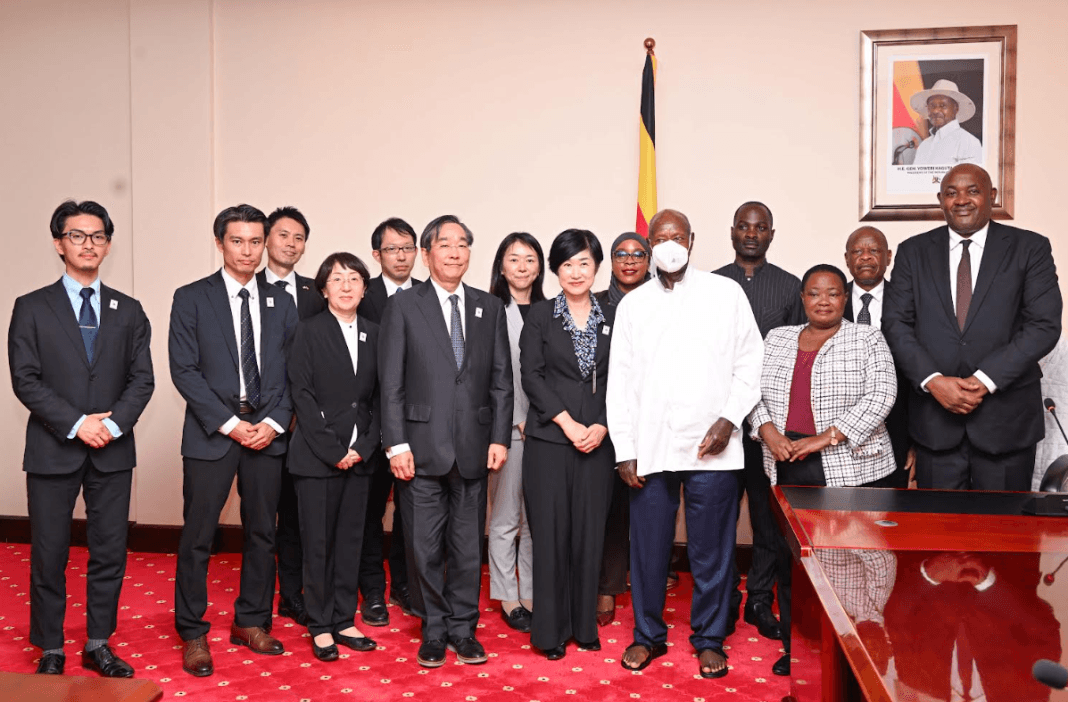
The bilateral talks were held on Tuesday at State House, Entebbe, with a Japanese delegation headed by Ambassador Takahashi Misako, Director General and Assistant Minister for African Affairs at Japan’s Ministry of Foreign Affairs.
The discussions reviewed bilateral ties across transport infrastructure, agro-industrialisation, energy, health, technical education, and regional peace and security.
President Museveni commended Tokyo for financing signature transport projects, highlighting the completed sections of the Kampala Flyover Project and the structural interventions on the Karuma Bridge.
To address national road maintenance bottlenecks, the President proposed equipping each local government unit with an independent fleet of earth-moving machinery, including motor graders, dump trucks, and compactors, rather than forcing districts to share equipment zones.
“I want each to have its own road equipment, the big ones, so that they don’t have shared equipment,” President Museveni said, noting that durable and easily serviceable machinery, including units from manufacturers such as Komatsu, would boost local infrastructure upkeep.
The President also requested a roundtable consultation with all Japanese enterprises currently active in Uganda to review their operational challenges and eliminate bureaucratic hurdles. He noted that meeting them as a group would enable him to address their concerns directly and help find immediate solutions.
President Museveni emphasized that direct Japanese investments in agricultural value addition remain central to Uganda's economic transformation, creating employment and expanding the global market for processed consumer goods. He reiterated that Uganda supports wealth creation both domestically and globally because a stronger global economy creates sustainable markets for products from different nations.
Ambassador Misako reaffirmed Japan’s commitment to Uganda’s development priorities through the Japan International Cooperation Agency (JICA) and commercial partnerships. She noted that Japan is exploring funding support for the expansion and improvement of the Kibuye–Busega corridor alongside additional phases of the Kampala Flyover.
On the Karuma Bridge reconstruction, the Ambassador revealed that a formal groundbreaking ceremony is scheduled for November 2026, extending an invitation for President Museveni to officiate at the event.
Tokyo will also continue financial and logistical aid to support Uganda's refugee-hosting framework. Ambassador Misako commended Uganda for hosting Africa's largest refugee population and reaffirmed Japan's dedication to assisting both refugees and host communities.
On trade and commerce, she reported that 17 Japanese companies currently operate bases across Uganda in transport, manufacturing, healthcare, and agribusiness. She applauded President Museveni for fostering a conducive business environment, noting that maintaining a free and fair climate remains essential for attracting sustained foreign direct investment.
The meeting also touched on human capital development. More than 200 Ugandans have completed studies under Japanese Government scholarships, while over 4,000 have benefited from JICA specialized training programs. Additionally, 846 JICA Overseas Cooperation Volunteers have been deployed to Uganda, with 37 currently active in communities across the country.
Ambassador Misako concluded by commending Uganda’s peacekeeping contributions under ATMIS in Somalia and regional stabilization efforts in the eastern Democratic Republic of the Congo. She highlighted that upcoming engagements under the Tokyo International Conference on African Development (TICAD) framework will continue to prioritize industrialisation and capacity building across the continent.