Uganda’s farm‑gate coffee prices have fallen for the first time in nearly a year, but Agriculture Minister Frank K. Tumwebaze says the slide is a temporary reaction to a worldwide oversupply—not a failure of domestic policy.
Latest quotations from the Ministry of Agriculture, Animal Industry and Fisheries (MAAIF) show:
| Variety | Current price (UGX/kg) | Recent high (UGX/kg) |
|---|---|---|
| Robusta FAQ | 10,000 – 11,000 | 13,000 |
| Robusta Kiboko | 5,000 – 5,500 | 6,500 |
| Arabica parchment | 14,000 – 15,000 | 16,000 |
| Drugar (clean) | ~14,000 | 15,500 |
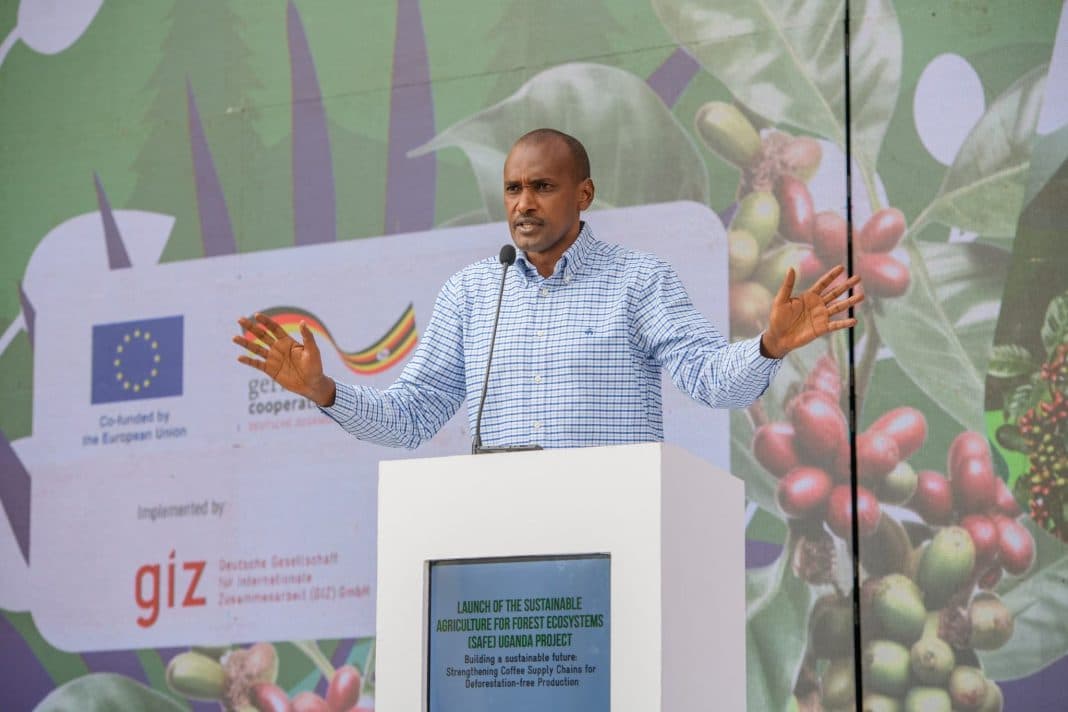
“The dip is driven by global market forces—chiefly bumper harvests in Brazil and Vietnam—and currency movements on commodity exchanges,” Tumwebaze told reporters on Sunday. “Uganda’s fundamentals remain strong.”
Why the market turned
Brazil expects a 0.5 % rise in production to 65 million 60‑kg bags this season.
Vietnam’s robusta output is projected at 31 million bags.
World production for 2025/26 is forecast at a record 178.7 million bags, against consumption of 169.4 million, according to the U.S. Department of Agriculture.
The surplus has dragged futures prices on the Intercontinental Exchange (ICE) in New York and London to one‑year lows, knocking Uganda’s farm‑gate values by roughly 15 %.
Uganda still outperforms
Despite the slump, Uganda exported 7.43 million bags worth US $2.09 billion between June 2024 and May 2025—up 22 % in volume and 94 % in value year‑on‑year.
“We are now ranked third globally for coffee quality by the Coffee Quality Institute,” Tumwebaze noted. “Our trajectory is intact.”
What farmers should do
Tumwebaze urged growers to resist panic sales and focus on:
- Quality control – selective picking, proper drying, and bulking only clean beans.
- Productivity gains – planting high‑yield seedlings, applying fertiliser, and using irrigation to cut unit costs.
- Value addition – investing in on‑farm processing to capture higher margins when prices rebound.
The ministry expects modest price recovery from mid‑July, once Brazil’s main harvest peaks and robusta deliveries from India and Vietnam taper off.
Price history offers perspective
Uganda’s average export price has swung between US $1.53 and US $3.11 per kilogram over the past decade. The current slide, Tumwebaze said, is “well within the historical band” and far above the 2020/21 trough.
A stronger U.S. dollar—against which coffee is traded—has squeezed exporter margins. MAAIF and the Bank of Uganda are monitoring forex trends, but officials emphasise there is no quick policy fix for global commodity cycles.
With new irrigation schemes coming on stream and farmers expanding acreage, Uganda aims to hit 20 million bags by 2030 under the Coffee Roadmap. “Volume is important, but quality will keep Uganda profitable even in soft markets,” Tumwebaze stressed.