
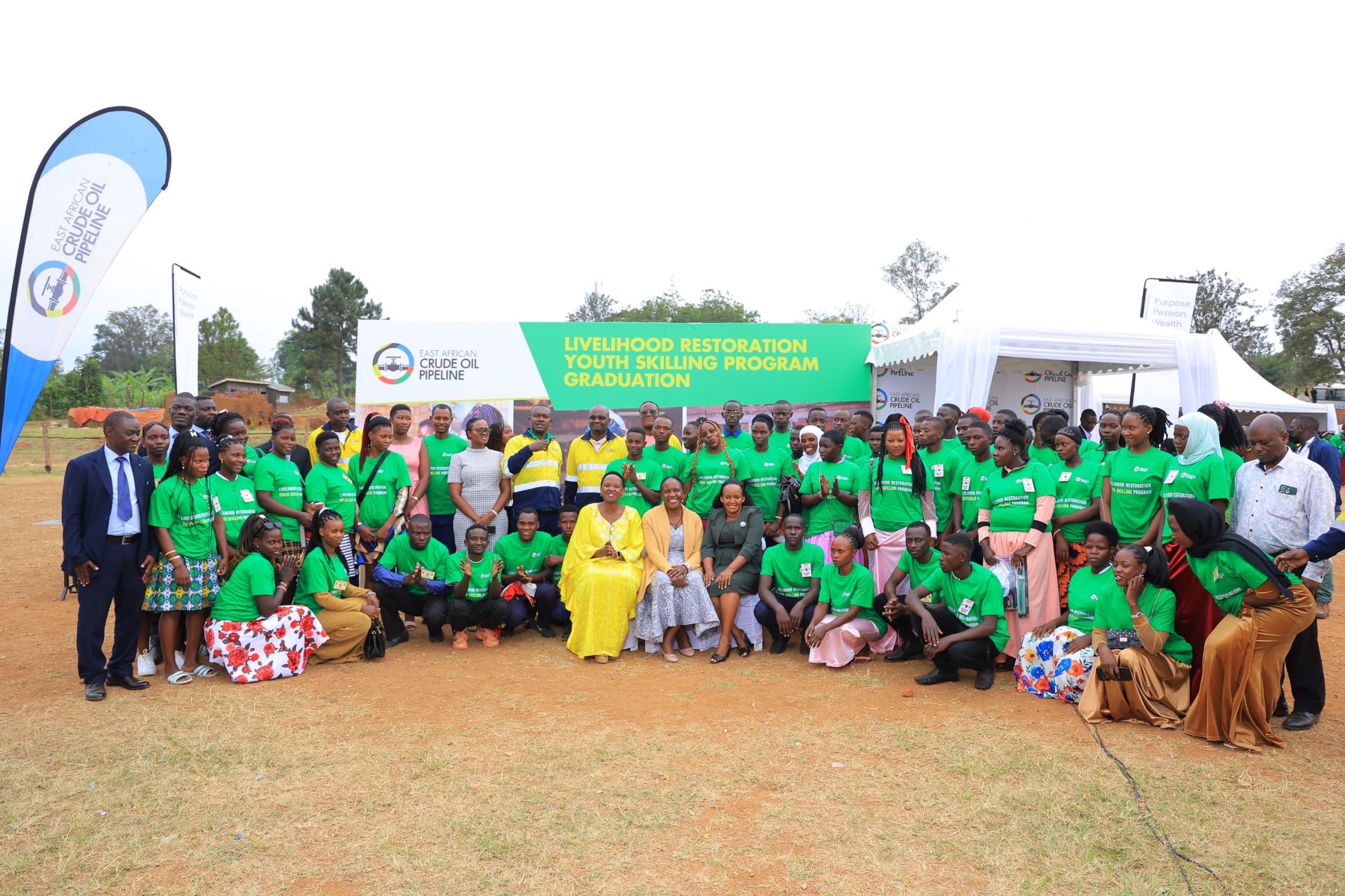
The East African Crude Oil Pipeline (EACOP) Ltd has facilitated the skilling of youth from project-affected households as part of the Resettlement Action Plan (RAP).
These vocational skills aim to enhance the capacity of affected households to earn an income and improve their resilience to shocks that may arise after displacement, either through self-employment or paid employment.
A total of 456 students, including 217 female students from affected households in Gomba, Kyotera, Lwengo, Rakai, and Sembabule districts, were enrolled at Mummy’s Institute of Beauty and Commercial Studies, St Charles Lwanga Technical Institute Butende, and Masaka Vocational Training Institute.
After completing 3 months of vocational training and 1 month of internship, the total number of youth trained from project-affected households along the entire pipeline route now stands at 1,476.
Speaking at the graduation ceremony, EACOP Social Performance Manager Rosie Birungi said, “We are honoured to empower youth from project-affected households with vocational skills. We believe that equipping them with the right skills will not only enhance their ability to start their own businesses but also enable them to engage in productive activities that can improve household incomes.”
The youth received skills in motor vehicle mechanics, welding & metal fabrication, motorcycle mechanics, electrical installation, hairdressing, plumbing, carpentry, cosmetology, and building & construction.
They will also receive starter kits specific to their vocational programs, supporting their journey to employment.
Support from EACOP contractors, ASIGMA Ltd, included tuition, scholastic materials, and welfare assistance during training. This initiative is part of the company's commitment to empower affected households through a livelihood restoration programme, aimed at restoring, transitioning, and improving livelihoods by utilizing available household resources post-resettlement.
According to World Bank data, more than 75% of the nation’s population is below 30 years of age. However, the Uganda Bureau of Statistics’ National Labour Force Survey 2021 reports that youth unemployment remains a significant challenge, with a rate of 17%, which is higher than the national average unemployment rate of 11.7%, as reported by the Ministry of Labour and National Development.
“Our greatest joy lies in making a difference in the lives of these young people by equipping them with valuable skills that will positively transform their future. We are confident that they will, in time, become role models for others, passing on the knowledge they have acquired. We encourage them to remain resilient and professional as they embark on this new journey.”