
EACOP Ltd., the company overseeing the East African Crude Oil Pipeline project, announced yesterday that it has successfully closed the first tranche of external financing. This significant milestone was achieved with support from a consortium of financial institutions, including African Export Import Bank (Afreximbank), the Standard Bank of South Africa Limited, Stanbic Bank Uganda Limited, KCB Bank Uganda Limited, and the Islamic Corporation for the Development of the Private Sector (ICD).
The financing agreement addresses previous challenges in securing funds for the $5 billion project, which aims to transport Uganda's crude oil from Kabaale to Tanga. For years, the financing of the pipeline proved difficult due to environmental and social concerns, with many banks and insurers refusing to support the project, citing risks to ecosystems, communities, and climate goals.
EACOP Ltd. is a joint venture with TotalEnergies holding a 62% stake, Uganda National Oil Company Limited (UNOC) and Tanzania Petroleum Development Corporation (TPDC) each owning 15%, and China National Offshore Oil Corporation (CNOOC) holding 8%.
Construction of the pipeline is progressing well in both Uganda and Tanzania, with a continued focus on safety, environmental sustainability, and local community engagement. As of the end of 2024, overall project progress exceeded 50%, with more than 8,000 Ugandan and Tanzanian citizens employed. Approximately $500 million has been spent locally on goods and services.
The East African Crude Oil Pipeline is designed to transport Uganda’s crude oil from Kabaale in Uganda to the Chongoleani peninsula near Tanga in Tanzania. Upon completion, it will have the capacity to transport 246,000 barrels of crude oil per day.
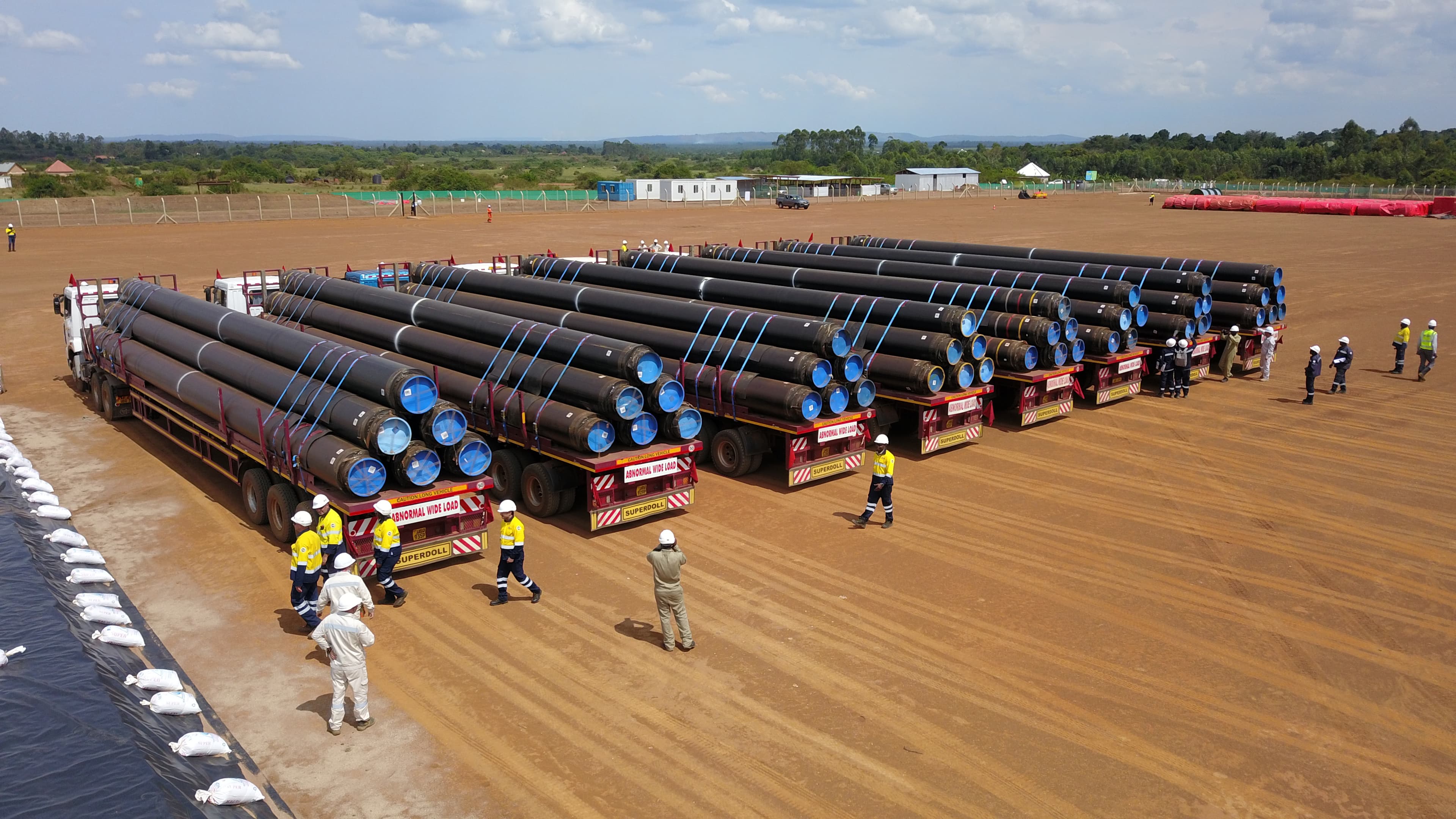
The 1,443 km pipeline (296 km in Uganda and 1,147 km in Tanzania) will be insulated and buried, featuring six pumping stations, two pressure reduction stations, and a marine export terminal in Tanzania equipped with a 3 MWp solar plant. The project adheres to high environmental and social standards, including those of the International Finance Corporation and the Equator Principles.