

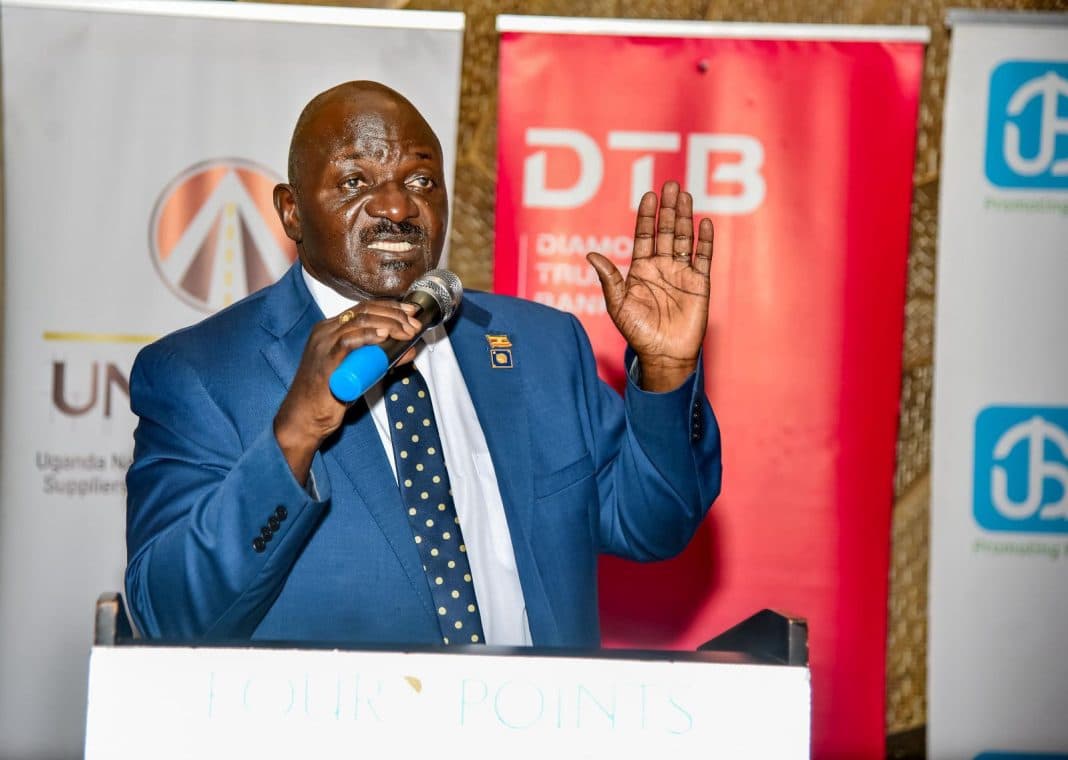
Minister of Works and Transport, Gen. Edward Katumba Wamala, has called on Uganda’s commercial banks to forge stronger partnerships with the construction sector by establishing specialized financing models to fuel infrastructure growth and restore trust.
Addressing stakeholders during the Construction Procurement and Finance Dialogue organized by the Uganda National Association of Building and Civil Engineering Contractors (UNABSEC) in Kampala, Gen. Wamala urged banks to design tailored credit windows modeled on those used in agriculture to support contractors facing cash flow constraints caused by delayed government payments.
“These delays have broken trust, leaving contractors to bear the brunt of high interest rates,” Gen. Wamala said. “We must rebuild confidence and empower contractors with sustainable financing to meet national development targets.”
The dialogue brought together bankers, contractors, and policymakers to confront persistent challenges in Uganda’s construction industry. Gen. Wamala emphasized that financial institutions must shift from transactional models to long-term partnerships with firms building key national projects, such as the Kampala–Jinja Expressway and the Standard Gauge Railway.
Diamond Trust Bank (DTB) CEO Geofrey Ssebaana backed the minister’s call, but also challenged contractors to improve accountability and project delivery.
“We’re ready with innovative, calculable solutions,” Ssebaana said, “but discipline and transparency are the keys to better financing terms.”
The dialogue aligns with Uganda’s UGX 9.1 trillion infrastructure budget for the 2025/26 financial year, which includes UGX 3.5 trillion for roads and earmarks funds to clear payment arrears in the Ministry of Works and Transport. The budget further emphasizes public-private partnerships (PPPs) to close funding gaps—a move Gen. Wamala endorsed.
UNABSEC President Kiara Binta Nkuranga praised the session as a turning point for the sector.
“This partnership between government, banks, and contractors is our springboard to transform the industry,” she said. “We’re also preparing firms with training on financial literacy and green building practices.”
Uganda’s construction sector contributes 12% to GDP, according to the Ministry’s 2024/25 report. The Ministry of Housing and Urban Development is also tackling a 2.4 million-unit housing deficit, with UGX 200 billion allocated to support affordable housing using eco-friendly materials.
Gen. Wamala linked his financing call to Uganda’s broader sustainability goals, urging banks to support projects aligned with climate resilience and low-carbon construction.
“We’re not just building roads—we’re building a resilient future,” he said. “Contractors must be seen not as clients, but as nation-builders.”
With UGX 100 billion budgeted for digital procurement systems, Wamala noted that efficiency tools can help eliminate project delays, further easing financing burdens and creating a conducive environment for growth.
As the event concluded, DTB and UNABSEC pledged to design practical loan frameworks and mentorship programs for small firms. Wamala’s final call to action was clear:
“Trust is the foundation of progress. Let’s build it together.”
With major infrastructure projects underway and financing reforms on the table, Uganda’s construction industry stands at a pivotal moment—ready to unlock its full economic potential through collaboration, innovation, and strategic investment.