
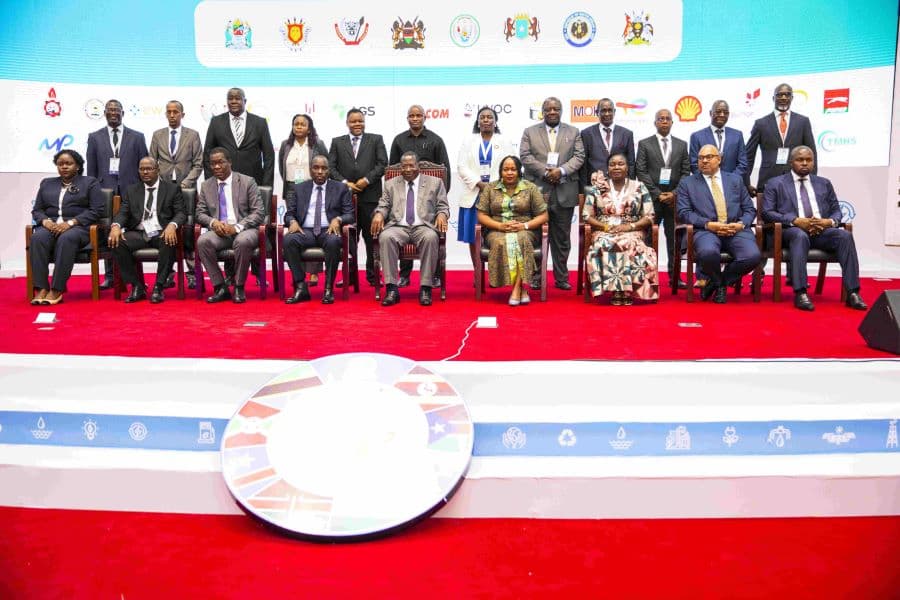
East African Community (EAC) partner states have been urged to channel petroleum revenues into development projects, job creation, and environmental restoration.
Tanzania’s Vice President, Philip Mpango, said countries should allocate a portion of petroleum earnings to a savings fund to secure future economic stability. He emphasised the need for responsible petroleum exploitation while preparing for long-term energy solutions.
“Petroleum remains crucial in today’s energy mix. By using these resources wisely, we can drive development and fund the transition to cleaner energy,” Mpango said.
He highlighted advances in oil and gas extraction, including cleaner technologies and carbon capture, which allow developing countries to maximise petroleum use sustainably.
Speaking at the 11th East African Petroleum Conference in Dar es Salaam, Mpango stressed the urgency of investing in renewable energy. He noted that Africa needs between $1 trillion and $2 trillion to meet clean energy targets by 2030.
“Given our local petroleum resources, African nations should develop them now to support energy transition. Public-private partnerships are key, with governments ensuring a favourable investment climate and private players offering financial and technical support,” he said.
Mpango acknowledged East Africa’s energy challenges, including limited modern energy access and high reliance on biomass, which slows economic progress. He cited efforts such as rural electrification and clean cooking initiatives as critical steps towards sustainable energy.
“Energy must be affordable to truly empower people. Governments have invested heavily in distribution and connections while offering subsidies to ensure accessibility,” he added.
He called for efficient resource use to meet rising energy demand, boost economic activity, and generate revenue for infrastructure and social services.
EAC remains a key oil and gas investment hub
EAC Secretary General Veronica Nduva said the region has gained global recognition as an investment hub for oil and gas.
“Discoveries in Uganda, Kenya, and Tanzania, alongside South Sudan’s continued production and new exploration in Burundi and Rwanda, show the region’s potential,” she said.
Despite global oil price fluctuations, East African economies have remained resilient. Nduva assured investors of stable, long-term returns in the region’s petroleum sector.
She also highlighted the role of artificial intelligence (AI) in transforming the oil and gas industry by improving exploration, extraction, refining, and distribution.
“Investing in digital infrastructure will drive efficiency, cut costs, and improve sustainability. Key areas include automation, predictive maintenance, smart refineries, spill detection, price forecasting, and risk management,” she said.
Since its inception, the East African Petroleum Conference has showcased key industry milestones. Nduva stressed that further growth depends on stable and harmonised legal, fiscal, and regulatory frameworks.
Uganda, Kenya push for structured oil sector growth
Uganda’s Minister for Energy and Mineral Development, Ruth Nankabirwa Ssentamu, revealed that the country benchmarked Norway’s model by setting up a petroleum fund. These funds are ring-fenced for infrastructure, including electricity, roads, and railways.
She said Uganda has strict laws against exporting unprocessed minerals, ensuring that petroleum revenue funds both energy transition and social development. She also noted that petroleum will provide gas as an alternative to biomass, reducing deforestation and health risks.
Kenya’s Energy and Petroleum Cabinet Secretary, Opiyo Wandayi, announced a restructuring of the country’s petroleum exploration blocks to align with global best practices.
“We have identified 10 highly productive blocks based on geo-scientific data. These will be available for Kenya’s first licensing round by September 2025, offering investors a transparent and competitive process,” he said.
These blocks are in Lamu and Anza basins, regions with proven discoveries and untapped potential.
To boost investment, Kenya has compiled seismic surveys, geological reports, and well data, all accessible at the National Data Centre. Infrastructure projects, including the expansion of Lamu port under the LAPSSET Corridor and the Lamu–Lokichar Pipeline, aim to enhance logistics and energy distribution.
Wandayi said Kenya is committed to developing a highly skilled workforce, with universities and technical institutes offering specialised training in petroleum engineering, geology, and geophysics.
“The government remains committed to capacity-building initiatives that support local expertise and industry innovation,” he added.
Somalia opens petroleum sector to investors
Somalia’s Minister of Petroleum and Mineral Resources, Dahir Shire Mohamed, assured investors that the country is now open for oil and gas exploration despite its history of instability.
He said Somalia enacted a petroleum law in February 2020, establishing the Somalia Petroleum Authority as the country’s regulatory body.
“Somalia presents vast opportunities in oil and gas. The country is now safe for investment, and we invite stakeholders to explore its potential,” he said.
The event was also attended by Tanzania’s Deputy Prime Minister and Minister for Energy, Dotto Mashaka Biteko, EAC Deputy Secretary General for Infrastructure, Andrea Aguer Ariik Malueth, ambassadors, permanent secretaries, and other key stakeholders.