

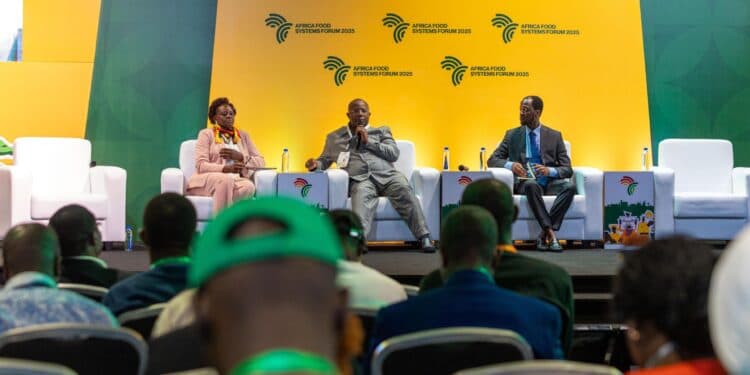
Uganda has launched an ambitious plan to secure 1.4 billion dollars (about 5.3 trillion shillings) in agricultural investments. The goal is to strengthen five major value chains: coffee, dairy, beef, maize, and soybeans, and position the country as a future food hub for East and Central Africa.
The plan was presented at the Africa Food Systems Forum (AFSF) in Dakar, Senegal, by a delegation led by State Minister for Agriculture Fred Kyakulaga Bwino. He said Uganda’s fertile land and youthful population make it an attractive destination for agribusiness. He noted that with a population of nearly 46 million, 78 percent of whom are under 35, Uganda offers both a large market and a ready workforce.
Kyakulaga added that the economy grew by 6.1 percent in 2024 and drew 3 billion dollars in foreign direct investment. He highlighted the country’s low inflation and stable environment, describing Uganda as open, competitive, and full of advantages for investors.
The Uganda Investment Authority (UIA) shared a detailed investment blueprint, outlining incentives such as a 10-year corporate tax holiday, VAT exemptions on seeds and machinery, and streamlined licensing through its One-Stop Centre.
UIA’s Peter Mulira said Uganda aims to triple coffee output from 7 million to 20 million bags through structured, sustainable growth. He added that dairy exports, currently valued at 3.2 million dollars, have the potential to reach 1.3 billion, with production expected to rise from 3.85 billion litres to 6.4 billion litres. On beef, he pointed out that local consumption stands at only 6 kilograms per person annually, creating room for expansion.
Mulira said Uganda’s access to vast regional markets, including the East African Community, COMESA, and AfCFTA, offers huge opportunities. He described the plan as a step towards making Uganda a food basket for Africa.
Development partners backed the initiative. AGRA’s Uganda Country Director, David Wozemba, stressed the need to cut post-harvest losses and highlighted the role of youth in agricultural transformation. He said new commitments would soon be made to scale up youth involvement in the rural economy.
The planned investments are expected to create 85,000 direct jobs, boost exports, and cut food imports. The initiative aligns with Uganda’s Vision 2040 and the upcoming National Development Plan IV.