


Uganda has launched its first-ever Sustainable Finance Curriculum to help banks and financial institutions integrate environmental and social sustainability into their operations, a move expected to accelerate the country’s transition toward a greener, more inclusive economy.
The curriculum, unveiled at the Sheraton Kampala Hotel, was developed jointly by aBi Finance Limited and the Uganda Institute of Banking and Financial Services (UIBFS), with funding support from the Royal Danish Embassy, Impact Fund Denmark, and the European Union Delegation to Uganda.
The new program aims to equip financial professionals with practical knowledge and tools to apply Environmental, Social, and Governance (ESG) principles in lending, investment, and risk management. It introduces modules on green lending, sustainability reporting, and climate risk assessment, designed to make finance a force for sustainable development.
“Through this curriculum, we are mobilising capital for green and inclusive businesses, especially those led by women, youth, and refugees,” said Mona Muguma Ssebuliba, CEO of aBi Finance Limited.
The initiative aligns with Uganda’s broader commitment to sustainable finance, including the National Green Taxonomy, which guides how the government and private sector classify green investments.
Christine Banuta from the European Union Delegation to Uganda said the curriculum complements global green growth efforts and supports Uganda’s upcoming Green Bond Framework, which is being developed in partnership with the Bank of Uganda.
“The biggest barrier to financing green enterprises is knowledge. This curriculum bridges that gap by building competence and confidence in sustainable finance,” Banuta noted.
Adam Sparre Spliid, Deputy Head of Mission at the Royal Danish Embassy, said Denmark remains committed to supporting Uganda’s green transition.
“This project helps redirect financial flows from black to green, aligning finance with sustainability and climate resilience,” he said.
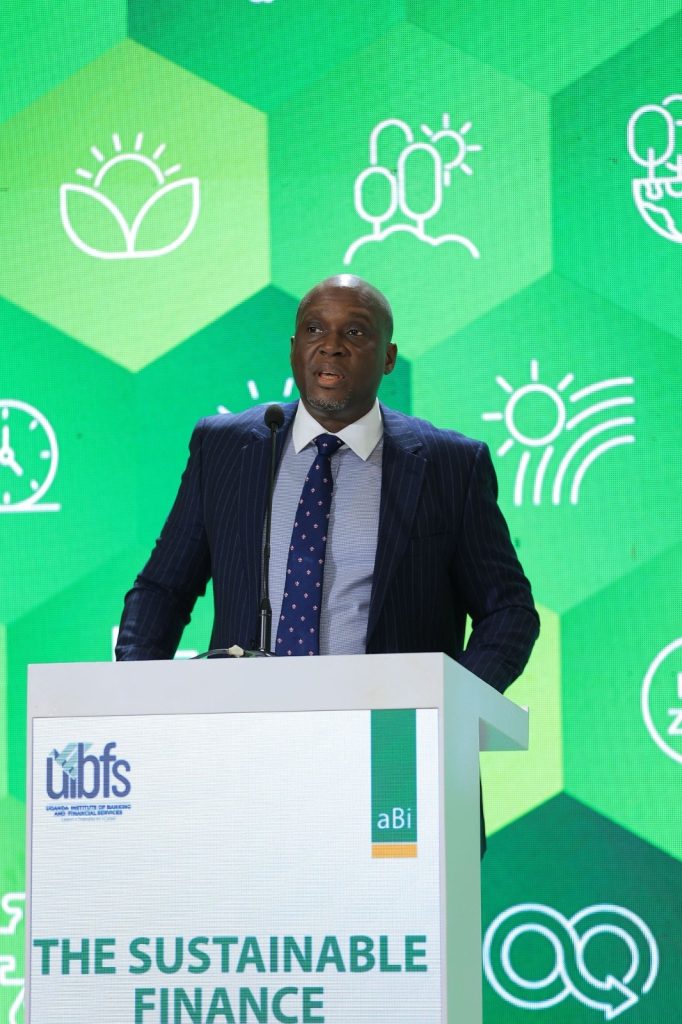
Felix Okoboi, Board Chair of aBi Finance, described the program as a turning point for Uganda’s financial industry.
“Profit alone is not enough, true success lies in creating value for people, communities, and the planet,” he emphasized.
Goretti Masadde, CEO of UIBFS, said the new curriculum strengthens the institute’s role as a center of excellence in financial services education.
“It will enhance the skills of finance professionals to meet the realities of a changing economy,” she said.
In his closing remarks, Michael Mugabi, Managing Director of Housing Finance Bank and Chairperson of the UIBFS Board, said sustainable finance must now be part of every bank’s core strategy.
“It is no longer optional. This program will empower financial professionals to lead Uganda’s transition toward a green and inclusive economy,” he concluded.