

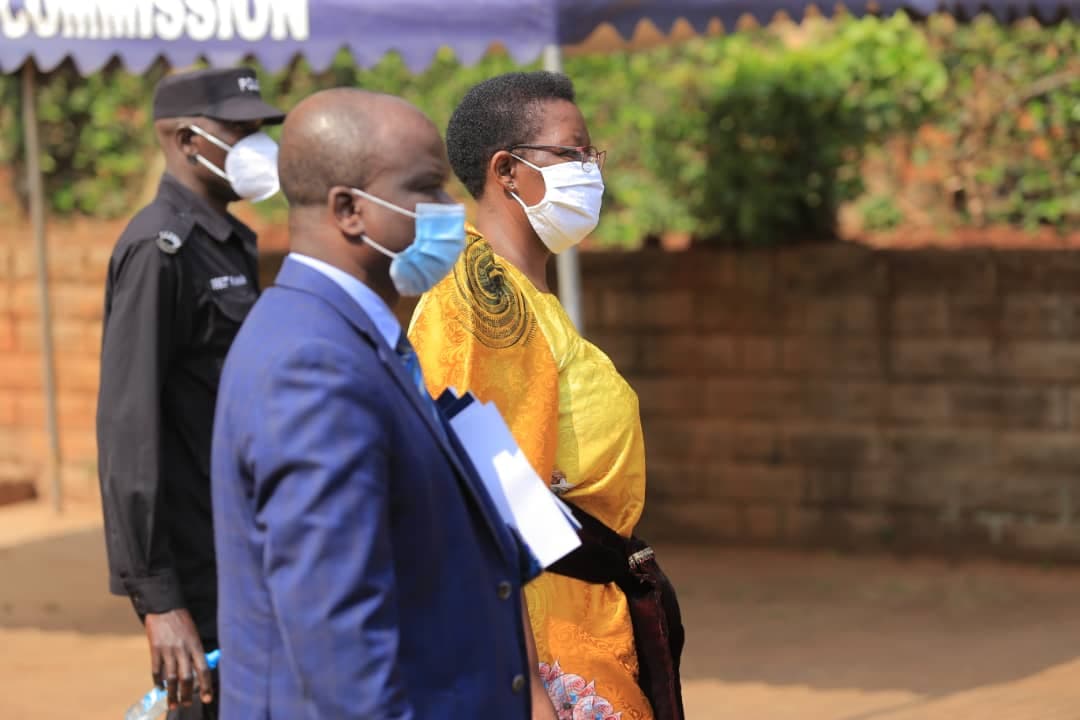
Uganda AIDS Commission (UAC) will on August 26 and 27 convene the Annual Joint AIDS Review where officials will assess whether Ugandan achieved the targets it set out in the National HIV/AIDS Strategic Plan for 2015/2020.
This will guide on strategizing to ensure that the East African nation achieves its goal of ending AIDS by 2030, the Minister for the Presidency Esther Mbayo said in a Monday media briefing.
Minister Mbayo says Uganda has made significant progress in reducing HIV incidence (the number of new infections), prevalence (the total number of infections) and AIDS-related deaths.
“In the late 80’s and early ’90s HIV prevalence was high at 18% in the general population. It is now at 6.8% for women and 4.2% for men; 2.8% among young women and 1.1% among young men,” she said.
“There are approximately 1,400,000 people living with HIV and 1,200,000 of these are on treatment. There are 51,007 new HIV infections and AIDS-related deaths now stand at 19,500.”
The minister hailed the efforts of UAC, UNAIIDS and the Ministry of Health that enabled the country to generate subnational data that is going to be very useful for HIV prevention advocacy campaigns.
The recently released Global HIV and AIDS statistics show that Uganda is among the front runners in reducing new HIV infections even though the burden remains huge.
She also applauded President Museveni for the unwavering leadership that he has offered over the years. “H.E the President has demonstrated huge interest and deep knowledge in programs like HIV and AIDS and most recently COVID19 which is driven by the desire to have a healthy population that ultimately drives industrialization,” the minister said.
The first person with AIDS was discovered in Rakai District in the ’80s. It soon became the epicenter of HIV infection and AIDS-related deaths alongside other thriving urban centers at that time.
For some years, many districts in Uganda such as those in the Karamoja region did not register any cases of HIV infection. However, to date, every district in Uganda has people living with HIV. Some of the districts with high HIV prevalence include; Kalangala at 18%, Mbarara at 15.2%, Gulu at 14.3%, Kabarole at 14.2%, Masaka at 11.5% among others.
Districts with a prevalence that is in between include; Kabale at 6.0%, Ntungamo at 5.6%, Isingiro at 4.8%, Rukiga at 4.9%, Luuka 2.7% among others. Districts with low HIV prevalence include; Nabilatuk at 0.2%, Karenga at 0.6%, Amudat at 0.8%, Yumbe at 1.2%, Kween at 1.4% among others.
The minister said the detailed information for all districts, different age groups, which is gender disaggregated showing the HIV prevalence rates and number of people on antiretroviral therapy -- will be distributed by Uganda AIDS Commission during the Annual Joint AIDS Review.
Risky social behavior
Minister Mbayo says that despite numerous HIV prevention interventions, there is increased engagement in risky sexual behavior including multiple sexual partners, low condom use among those engaging in high-risk sex, and decline in age of sexual debut.
“Other challenges include widespread self-stigma, low uptake of couple testing, and significant proportions of people, especially men living with HIV, who do not know their HIV status,” she said, adding: “There remains a significant link between HIV infection and sexual and gender-based violence (SGBV). Survivors of sexual violence seldom access HIV prevention services such as Post Exposure Prophylaxis (PEP) necessary for HIV prevention.”
Moving forward
Uganda has pledged to End AIDS as a public health threat by 2030 and the minister said the following has to be done to realize this:
1. Implement behavior change interventions and disseminate messages for HIV Prevention to scale in order to result in significant and sustainable declines in new HIV infections.
This is especially important during this time when the country is dealing with the COVID 19 pandemic which has exacerbated domestic violence and transactional sex-key factors in the spread of HIV.
2. While it was correct for HIV prevention programming to focus largely on urban hotspot areas where most new infections are expected, the country also needs to pay attention to the vulnerabilities and risk factors in the general population in order to reach the goal of ending the epidemic by 2030.
This should be coupled with deliberate engagement of community structures and networks of People Living with HIV to support the different facets of program planning, design, governance, leadership, implementation, monitoring and evaluation.
3. While efforts to increase local financing of the response led to the enactment of the AIDS Trust Fund (ATF); Government directive to all accounting officers to allocate 0.1% of annual operational budgets towards mainstreaming HIV interventions in their respective sectors; and creation of the “One Dollar Initiative” (ODI) to generate additional funding from the private sector, it is important to fully roll out all these funding sources to ensure the sustainability of the response.
The country also needs to optimize programme efficiencies, minimize losses and focus on reaching the underserved sub-populations.