
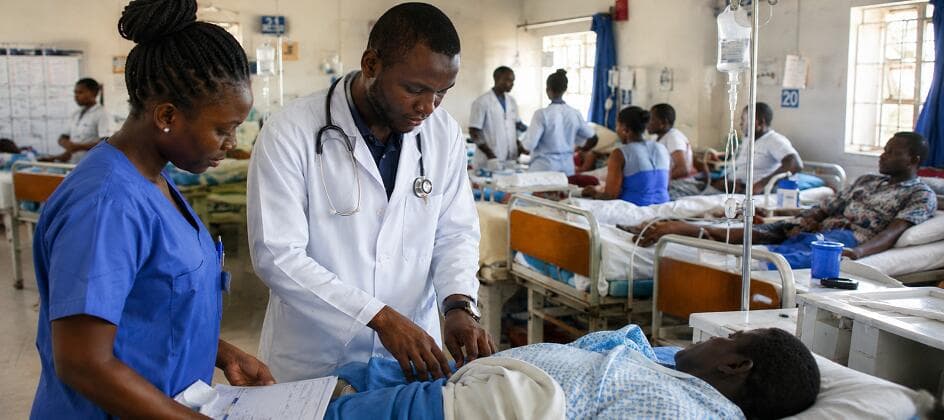
The World Health Organization has warned that Africa’s growing number of health workers still cannot meet the continent’s healthcare needs due to unemployment, migration and weak health systems.
The warning appears in the State of the Health Workforce in Africa 2026: Plan. Train. Retain. report launched on May 6, 2026 during the Second Africa Health Workforce Investment Forum in Accra, Ghana.
The report shows that Africa is producing more health professionals than before, but millions of people still lack access to proper healthcare services.
WHO said the crisis no longer stems only from limited training capacity. It said poor employment systems, weak retention policies, unequal distribution of workers and inadequate financing now drive the problem.
Africa’s health workforce grew from 4.3 million workers in 2018 to 5.72 million in 2024. Despite the increase, the continent still has only 46 per cent of the health workers needed to meet demand.
WHO revised Africa’s projected health workforce shortage in 2030 from 6.1 million to 5.85 million workers. The organisation, however, warned that the progress remains fragile without stronger reforms and investment.
“Africa’s health workforce crisis is no longer defined by scarcity alone, but by systemic failure. We are training more health workers than ever before, yet too many remain unemployed while millions go without care. Without bold investment and coordinated reform to plan, train and retain health workers, progress toward universal health coverage will remain out of reach,” said Dr Mohamed Yakub Janabi.
The report revealed that about 943,000 trained health workers in Africa remained unemployed in 2024 even as health facilities struggled with staff shortages.
More than 325,000 graduates join the workforce every year. However, several countries still fail to absorb many of them into stable employment.
WHO blamed the mismatch on poor coordination between education systems, labour markets and public health financing.
The report also highlighted rising migration pressures. Nearly 46 per cent of health workers surveyed said they planned to leave their countries in search of better pay, working conditions and career opportunities abroad.
Absenteeism also continues to affect healthcare delivery, with losses estimated at up to 20 per cent of national health wage bills.
WHO further raised concerns about healthcare quality. Health workers correctly diagnose about 62 per cent of cases, while patients receive proper treatment in only 40 per cent of those cases.
The organisation said investment in health workers could generate major economic and social returns. According to the report, every US$1 invested in the health workforce could produce up to ten times in financial returns and more than thirty times in wider social and economic benefits.
The report estimated that African countries would need to increase health workforce spending by about US$4 per person annually or raise workforce budgets by roughly 15 per cent each year to close the gap.
WHO concluded that Africa’s challenge now lies less in training health workers and more in building systems that can employ, support and retain them where they are most needed.
 Africa
Uganda Partners with UK Diaspora to Drive Local Investment
State House Diaspora Unit Head Mohammed Bagonza has met with UEUKA President Dr. Manoj Joshi in London to build a structured investment and skills-transfer pipeline for Ugandans abroad.