

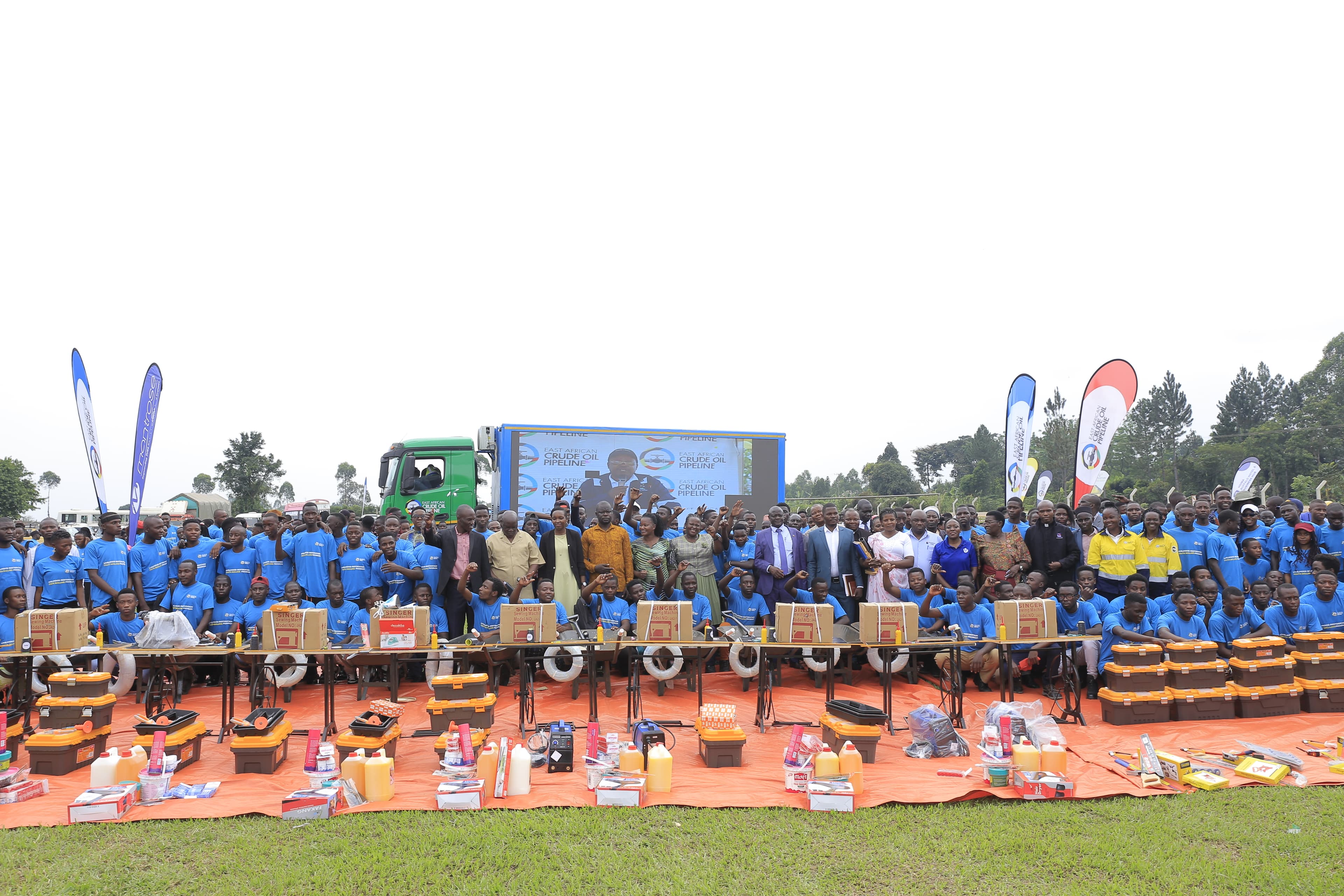
The East African Crude Oil Pipeline (EACOP) Ltd is skilling youth from households affected by the project as part of its Resettlement Action Plan (RAP). This initiative is designed to empower these households with vocational skills that can improve their income opportunities and resilience post-resettlement, either through self-employment or paid work.
Out of 754 students graduating from affected households in Hoima, Kakumiro, Kikuube, Kyankwanzi, and Mubende districts, 249 are female. These students trained at institutions like St. Simon Peter’s Vocational Institute in Hoima, St. Peters Vocational Training Institute in Mubende, Buhimba Technical Institute in Kikuube, and Millenium Business School in Hoima. They completed three months of vocational training and a one-month internship. Across the entire pipeline route, a total of 1,020 youth have received training.
The training covered fields such as tailoring and garment design, welding, building and construction, carpentry and joinery, motor vehicle and motorcycle mechanics, hairdressing, catering, and electrical installations. To kickstart their careers, the youth will also receive starter kits tailored to their specific vocational programs.
This effort is part of EACOP's Livelihood Restoration Program, aimed at restoring and improving the livelihoods of project-affected households (PAHs) by helping them transition to sustainable income generation.
About program
The program’s goal is to ensure that households whose livelihoods have been disrupted can restore or improve their income levels, production capacity, and living standards. The initiative is being implemented in three phases:
Phase 1
Short-term food security support in the form of dry rations or food baskets is provided to eligible households for 6-12 months after they vacate their land. So far, 1,949 out of 2,257 heavily impacted households have benefited. Support levels depend on the degree of impact and household size.
Phase 2 and 3
To enhance food security and income, PAHs are enrolled in agricultural improvement programs, enterprise development, and vocational training. Currently, 2,938 out of 3,400 eligible households across 10 districts are benefiting from agriculture productivity support.
This assistance includes hands-on training in modern farming techniques, crop and animal rearing, and the use of improved technologies. Starter packs—containing disease-resistant, water-stress-tolerant seeds and seedlings for crops like maize, beans, bananas, cassava, and coffee—are also provided.
The program connects PAHs with local suppliers and buyers to establish long-term partnerships, ensuring the sustainability of the progress achieved.
Through these measures, EACOP aims to empower affected communities and build resilience as they transition to new livelihoods.