

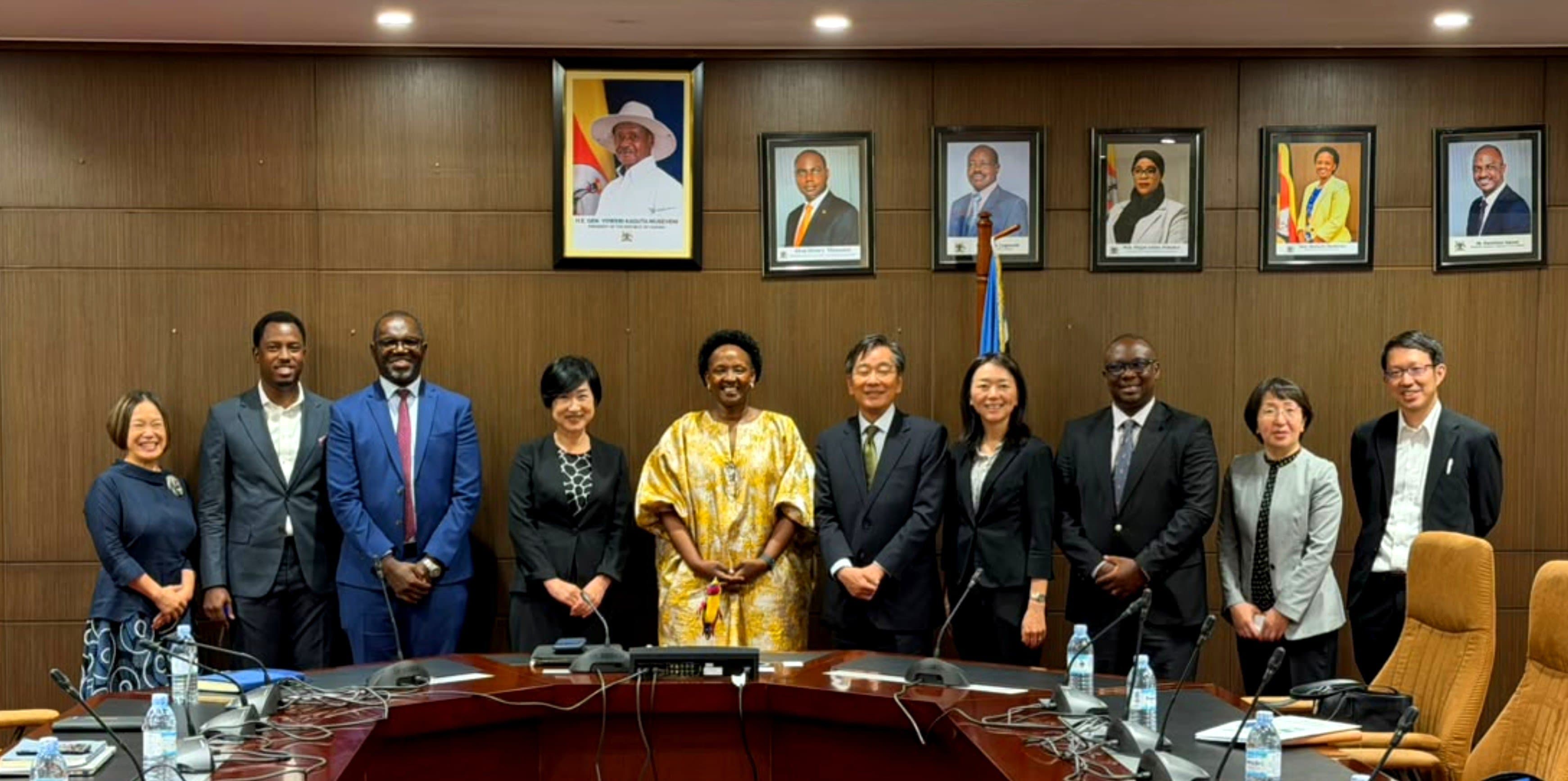
Uganda is seeking deeper Japanese support for the Parish Development Model (PDM), SACCO digitalisation and youth enterprises as the government pushes to expand financial inclusion.
State Minister for Microfinance Shartsi Musherure held talks with a Japanese delegation led by Takahashi Misako, Japan’s Director General and Assistant Minister for African Affairs.
The meeting explored new areas of cooperation between Uganda and Japan, with PDM taking centre stage.
Musherure said the programme had reached 3,783,108 beneficiaries by September 2026. The government has injected about Shs4.317 trillion into the Parish Revolving Fund through 10,589 PDM SACCOs across the country.
“The programme is therefore no longer simply a small loan initiative. It is becoming an important platform for bringing millions of Ugandans into the formal financial and productive economy,” Musherure said.
She said Uganda wants to use its large microfinance network to attract Japanese technology, expertise and investment.
“We see an opportunity to combine Uganda's scale and development priorities with Japanese technology, knowledge and investment,” she said.
The government wants support to strengthen SACCOs and community finance groups through digital systems, better savings products, stronger internal controls and improved financial management.
Uganda also hopes to learn from Japan’s experience in running cooperative institutions and training their managers and leaders.
The two sides discussed a proposed Uganda-Japan Youth Enterprise and Innovation Facility. The initiative would combine access to finance with technical training, business skills and digital technology.
Japan, through the Japan International Cooperation Agency (JICA), has already supported Uganda’s start-up sector. Ten Ugandan start-ups from seven industries joined a JICA-backed acceleration programme in 2024.
The talks also covered green financing for small businesses. Areas under consideration include solar power for rural enterprises, solar-powered irrigation and clean cooking technologies.
Musherure said Uganda was seeking to build a financial system that goes beyond issuing small loans.
“Uganda does not only view microfinance simply as the provision of loans but wants to build a sustainable financial ecosystem in which ordinary Ugandans can save, access affordable credit, invest, insure themselves and manage risks to grow their businesses,” she said.
She said the National Financial Inclusion Strategy II, which runs from 2023 to 2028, focuses on physical and digital access to finance, consumer protection, financial literacy and inclusive green financing.
The government is pursuing the strategy through PDM, Emyooga and private sector programmes.
Musherure also praised Japan’s long-standing support to Uganda. She said Japanese assistance had benefited health, education, refugee welfare and major infrastructure projects, much of it through JICA.
Misako, who was accompanied by Japan’s Ambassador to Uganda, Sasayama Takuya, said Tokyo wants to deepen its relationship with Kampala.
She outlined Japan’s Africa policy around peace, shared economic growth and cooperation with the next generation.
“We believe that these three pillars of Japan’s diplomacy towards Africa, as presented by Minister Motegi, are highly relevant to Japan–Uganda relations,” she said.
Misako said Japan was interested in expanding cooperation with Uganda in investment, logistics, regional connectivity, human resource development, science, technology and innovation.
She also pointed to possible cooperation in natural resources, including critical minerals.
Japan, she said, wants to continue talks with Uganda to identify areas where the two countries can work together.