

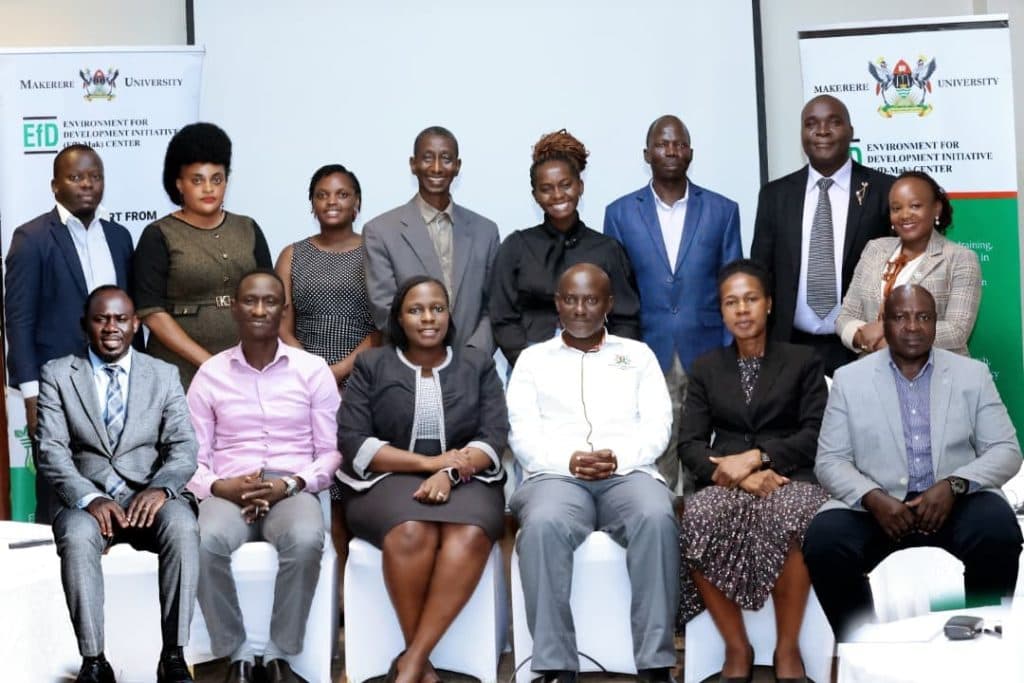
Researchers, government officials and private sector actors met in Kampala on December 4, 2025 to set a clear path for expanding Climate Smart Agriculture (CSA) in Uganda, as the country grapples with severe climate shocks, stagnant farm productivity and rising poverty.
The annual workshop, held at the Sheraton Kampala Hotel and organised by the Environment for Development (EfD) Mak Centre through its Inclusive Green Economy (IGE) Programme, aimed to strengthen links between research and policy and address long-standing barriers to CSA adoption. Public servants in the IGE programme are required to show how they can turn training into practical solutions, with this year’s focus on using CSA to support sustainable production, reduce poverty, promote gender inclusion and build resilience across value chains.
The meeting drew participants from key ministries, academia, civil society, private suppliers of solar-powered irrigation technologies, farmers’ representatives and the media. Discussions centred on how to boost farmer uptake of CSA and keep agriculture at the heart of Uganda’s economic growth.
Delivering the keynote address on behalf of the Commissioner at the Ministry of Agriculture, Animal Industry and Fisheries, Emmanuel Odeng warned that Uganda’s agricultural sector is under strain. He said climate change, weak investment in resilient systems, and degrading natural resources are threatening productivity and deepening poverty.
Odeng pointed out that agriculture still contributes 24% of GDP, 35% of export earnings and employs more than 80% of Ugandans. Yet, its share of GDP has fallen from 34.1% in 2009 to 24% in 2022. He noted that yields are dropping, water sources are shrinking and heat waves are rising, leaving communities vulnerable. Between 2019 and 2021, 1.4 million Ugandans slipped back into poverty despite some households escaping it.
He highlighted the growing number of climate-related disasters such as droughts, floods, landslides and siltation of major water bodies, including Lake Kyoga. Uganda’s forest cover, wetlands and grazing lands continue to decline, with more than 6,000 gazetted wetlands affected by encroachment. He said the Ministry’s models show a steady decline in natural resources over the last decade.
Odeng urged rapid scale-up of CSA practices in crops, livestock and fisheries. He emphasised innovations in irrigation and water harvesting, agroecology, soil rehabilitation, mechanisation, climate-resilient seed systems, afforestation, agroforestry and improved post-harvest handling. MAAIF aims to increase production across value chains by 40%, supported by updated CSA compendiums being developed by NARO.
He challenged researchers to prioritise areas that strengthen farmer resilience, raise productivity and reduce losses along the value chain. He said these issues must shape Uganda’s CSA agenda and guide policy and investment decisions.
EfD Mak Centre’s representative, Dr John Sseruyange, also called for stronger collaboration between researchers and policymakers. He said climate change is no longer abstract but a daily reality for farmers. He warned that research risks being ignored when it is not aligned with policy needs.
Sseruyange said declining productivity, poor soil health, stressed water resources and shrinking ecosystems show the urgency of climate-responsive farming. He argued that Uganda cannot advance CSA without research that responds to real problems facing farmers.
He urged stakeholders to focus on practical innovations, better post-harvest handling, improved mechanisation, soil health and climate-resilient farming techniques. He echoed Odeng’s call for clarity on which CSA approaches should guide future research and policy support.
Policy Engagement Specialist Dr Peter Babyenda stressed that Uganda is moving too slowly on CSA, despite its importance for food security and economic stability. He said farmers face major barriers, including limited awareness, high input costs, weak extension services and low capacity among extension workers.
Babyenda said 96% of farming households depend on rain-fed agriculture, making them extremely vulnerable to climate variability. He warned that Uganda’s growing population, coupled with reduced productivity, threatens long-term food security and the country’s development goals.
He called for stronger farmer training, targeted policies, improved extension services and greater inclusion of women and youth in CSA initiatives. He said CSA offers “triple wins”, higher productivity, greater resilience and mitigation benefits, but only if scaled effectively and aligned with local needs.
IGE fellow Opeet Thomas presented the Transformation Initiative, which aims to improve CSA adoption among smallholder farmers. He said climate shocks such as unpredictable rainfall, long dry spells and extreme heat continue to disrupt planting seasons. He noted that low CSA adoption is linked to poor awareness, limited extension capacity and high costs of inputs.
Opeet stressed the role of extension workers in bridging knowledge gaps, but said many lack resources and institutional support. He highlighted the potential of technologies such as small-scale irrigation and insect-based feed systems but noted that adoption remains low because many farmers cannot access or afford them.
He said the Transformation Initiative aims to generate evidence to guide policy and practical interventions. If well implemented, he said, CSA can boost yields, enhance resilience and support environmental sustainability.
Participants at the workshop called for stronger policy engagement, better extension support and more collaboration across sectors to scale CSA nationwide. They emphasised innovation, policy alignment and farmer engagement as key drivers of resilience and productivity. They also underscored the need to integrate CSA into national policies to protect food security and rural livelihoods.
Stakeholders identified three priority areas for CSA: research to strengthen resilience and reduce poverty; approaches that sustainably increase productivity; and strategies to cut post-harvest losses. They also urged investment in farmer-to-farmer extension models and community-based facilitators to ensure knowledge reaches remote communities.
The workshop closed with a shared commitment to refine Uganda’s CSA strategy and ensure research, policy and practice move together to transform agriculture.