

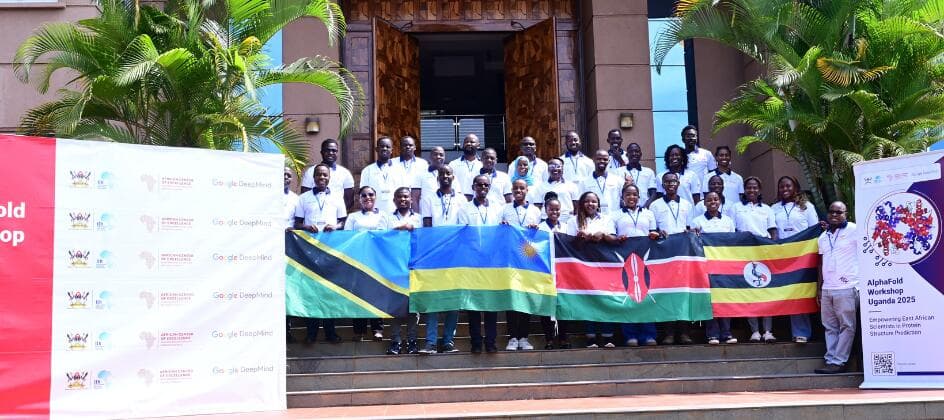
The African Centre of Excellence in Bioinformatics and Data-Intensive Sciences (ACE-Uganda) has announced a partnership with Google DeepMind to equip young African scientists with AI tools and mentorship.
The programme will support early-career researchers from Uganda, Kenya, Rwanda, and Tanzania, with a strong focus on antimicrobial resistance (AMR). ACE-Uganda will also host a regional “AI for AMR” symposium to build skills in applying AI to biological research.
“Through this partnership, we are not just providing access to technology; we are nurturing the talent that will produce the next great biological breakthroughs, creating solutions for Africa, by Africans,” ACE-Uganda said.
Researchers will attend hands-on workshops that integrate tools such as AlphaFold and AlphaMissense. They will join an intensive four-day scientific challenge to solve complex biological problems. A mentorship scheme will pair students with AlphaFold experts for projects in proteomics and structural biology. ACE-Uganda’s virtual reality facilities will help visualise protein structures in 3D.
The collaboration will also provide access to advanced computing resources for data-intensive studies. This should speed up discoveries in Africa.
Beyond AMR, the partnership will support research on malaria, HIV, tuberculosis, sickle cell disease, cancer, and diabetes.
ACE-Uganda was founded by the Infectious Diseases Institute (IDI) and Makerere University’s College of Computing & Health Sciences, in partnership with the U.S. National Institute of Allergy and Infectious Diseases and the Office of Cyber Infrastructure and Computational Biology (NIH/NIAID/OCICB). It is one of only two such centres on the continent.
The centre focuses on computational biology and big-data analysis and has a high-performance computing cluster, a tele-learning centre, collaborative spaces, and a virtual-reality room for advanced 3D and VR teaching and diagnostics.