

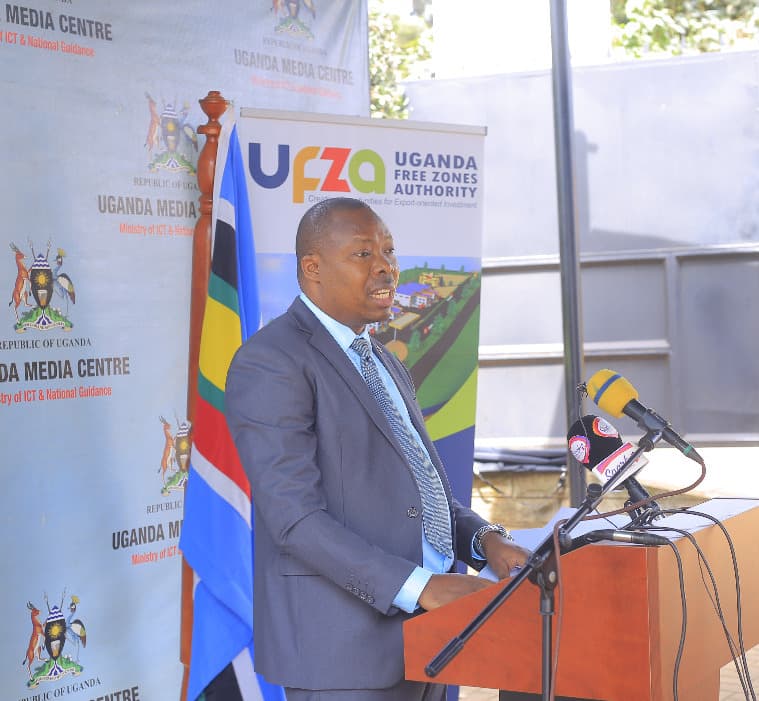
The Executive Director of Uganda Free Zones Authority (UFZA) Hez Kimoomi Alinda revealed that Free Zones contributed US$ 1.247 billion (about Shs4.2 trillion) to the county's export earnings, up from US$154 million in FY2019/20.
The director, who was Friday presenting the sector's Annual Performance for the Financial Year 2020/21, noted that the products that were exported from the Free Zones included Semi-manufactured gold, cocoa beans (whole or broken, raw or roasted), flowers and horticulture products, sandalwood essential oils, tobacco (partly/wholly stemmed), natural calcium phosphates and wheat flour among others.
The top ten destinations for exports from Free Zones were the United Arab Emirates (UAE) with a significant increase to US$1.16 billion from US$106.4 million recorded in FY2019/20. The Netherlands ranked second contributing (US$39.49 million), an increase from US$32.9 million in FY2019/20. Other major destinations were Belgium (US$6.88 million), Turkey (US$2.66 million), Germany (US$2.34 million), Italy (US$ 2.21 million), the United States of America (US$1.93 million), Russia (US$1.52 million), and South Sudan (US$1.27 million) among others.
"The development of Free Zones offer an opportunity for the Government of Uganda to target resources towards tackling challenges of low value-added agricultural production, and manufacturing activities, in order to deliver new employment and market opportunities," Alinda said.
Government appropriated and released to UFZA a budget of Shs8,964,934,000 for the Financial Year 2020/21 for both recurrent and Development expenditure.
Despite the disruptions caused by the COVID-19 pandemic, UFZA, embarked on numerous activities that saw the commencement of the construction works of the first public Free Zone in Uganda at Entebbe International Airport and also issued three (3) Developer Licenses to the private sector companies.
Entebbe International Airport Free Zone, located within the precincts of Entebbe International Airport, will attract six (6) Private Operators and one Anchor firm engaged in agro-processing and manufacturing for export.
The Free Zone is projected to generate an additional US$13.4 million in private sector investment at operationalization and create export earnings of over US$ 4.02 million per year.
The Authority started the implementation of the second Strategic Plan 2020/21-2024/25 which is aligned to seven programmes of the third National Development Plan. These include: Agro industrialisation, Mineral Development, Sustainable Development of Petroleum Resources, Private Sector Development, Manufacturing, Sustainable Energy Development, and Sustainable Urbanisation and Housing.
In the FY 2020/21, the actual employment in Free Zones increased to 8,611 from 6,382 jobs in FY2019/20. The declined in FY2019/20 resulted from the disruptive effects of the COVID-19 pandemic on the economy.
The total value of local purchasing and subcontracting stood at US$13.27 million creating the much needed backward linkages in the economy.
The Authority says it encountered some challenges during the FY 2020/21 such as lack of Strategic, expansive and serviced industrial land for Free Zones, delays in issuance of Statutory Instruments for licensing Free Zones and delay in operationalization of the Free Zones Customs Management Module on the Uganda Electronic Single Window.
"Going forward, fast-tracking issuance of Sanitary and Phytosanitary Certificates to exporters of fresh produce for export; development and installation of a Gama Radiation Facility at Entebbe International Airport; and intentional acquisition of strategic and expansive land will propel development of export-oriented investments in Free Zones," reads an official statement.
A Free Zone is a gazetted geographical area where processing and manufacturing of goods for export is carried out without being subjected to import and export duties and levies to make the goods competitive on the global market.