
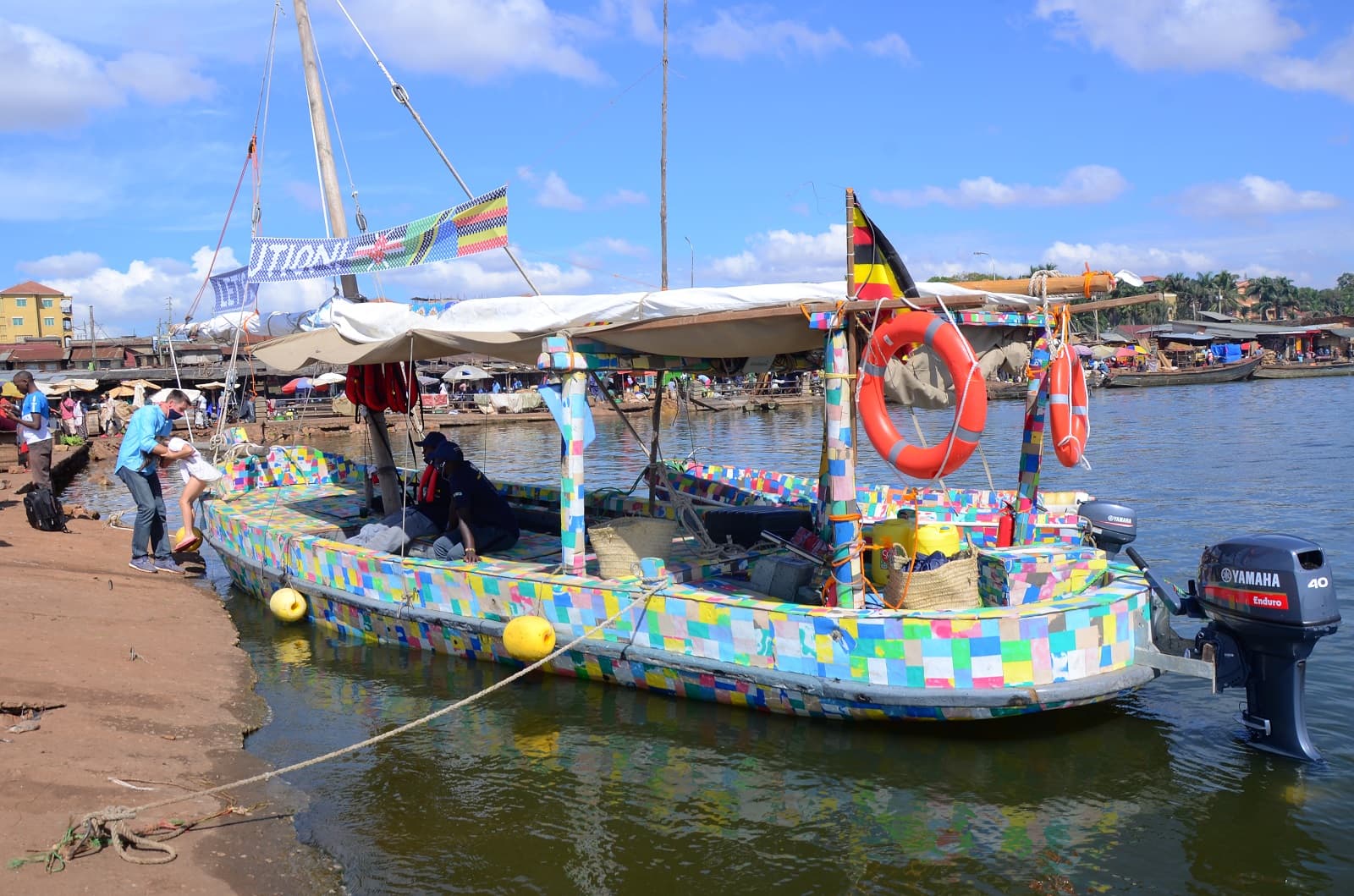
Flipflopi, the world’s first sailing dhow made from 100% recycled plastic, has been in Uganda for a week and some days as part of its voyage on Lake Victoria, Africa’s largest freshwater lake.
The expedition, which started in Kenya on March 8 -- is aimed at spreading the message against unnecessary single-use of plastics by rooting for a circular economy.
On Saturday, at Ggaba Beach Hotel, an exhibition was held to show people around the boat and other exciting products local creatives have developed from recycled plastics. Speaking to newsmen, Ben Morison, co-founder of the Flipflopi project, noted that the boat “was built to show the world that it is possible to make valuable materials out of waste plastic, and that single-use plastic really does not make sense.”
“By sailing around the lake, we hope to inspire people to create their own waste-plastic innovations and adopt circular waste management solutions that help build greener businesses, whilst also taking plastic out of the environment,” he went on.
“Together with communities across the Lake Victoria region we hope to bring awareness and innovative solutions to beat pollution and support a green recovery in East Africa.”
Lake Victoria, supporting 40 million East Africans, symbolizes the catastrophic effects of human activities and climate change, among other issues, resulting in significant water pollution which threatens the health and livelihoods of communities. A recent study estimated that 1 in 5 of the fish in Lake Victoria had ingested plastic.

Another study ubiquitously recorded microplastics in surface waters in several sites of Lake Victoria. The Flipflopi project showcases alternative uses of plastic waste and the possibilities of circular economy approach to tackle pollution.
Over a three-week period, Flipflopi will circumnavigate the lake from Kisumu, Kenya, to several locations in Uganda, finishing in Mwanza, Tanzania, to bring attention to the environmental problems affecting the lake, inspiring communities to adopt circular-waste solutions and facilitating cross-border discussions around how to beat pollution.
The boat was brought into the country at the time of celebrating Uganda Water and Environment Week (UWEWK). Flipflopi’s Lake Victoria expedition will include some 10 stops around the lake that will engage school children, community leaders, conservationists, business leaders and policymakers, demonstrating alternate uses of waste plastic, highlighting other circular waste models and calling for an end to single-use plastics. Flipflopi is just one example of an African circular solution to the global pollution problem.
In Uganda, the founders of Reform Africa are turning plastic waste into sustainable and waterproof bags, whilst providing school children in rural areas with bags for free.
In Tanzania, a collective of local artisans known as ‘Made by Africraft’ are introducing youth and the unemployed to developing sustainable handicrafts to create a livelihood. In Kisumu on the shores of Lake Victoria, CIST Africa are making hand sanitizer from invasive water hyacinth.
Innovators like Sanergy are turning Nairobi’s untreated organic waste into organic fertiliser for crops, feed for livestock, and fuel briquettes for energy. During the event, multiple officials called for behavioral change as a means to fighting unnecessary single use of plastics.
Louise Ellis, the British Deputy High Commissioner to Uganda, said that her government is committed to supporting projects that are involved in environmental protection.
“We want to help the project influence and educate everyone to participate in the climate change fight,” she said.
The Flipflopi initiative is supported and by various partners including the national governments of Uganda, Kenya and Tanzania, UNEP, The UK’s Foreign Commonwealth and Development Office (FCDO), the French Development Agency (AFD) and The European Union.