

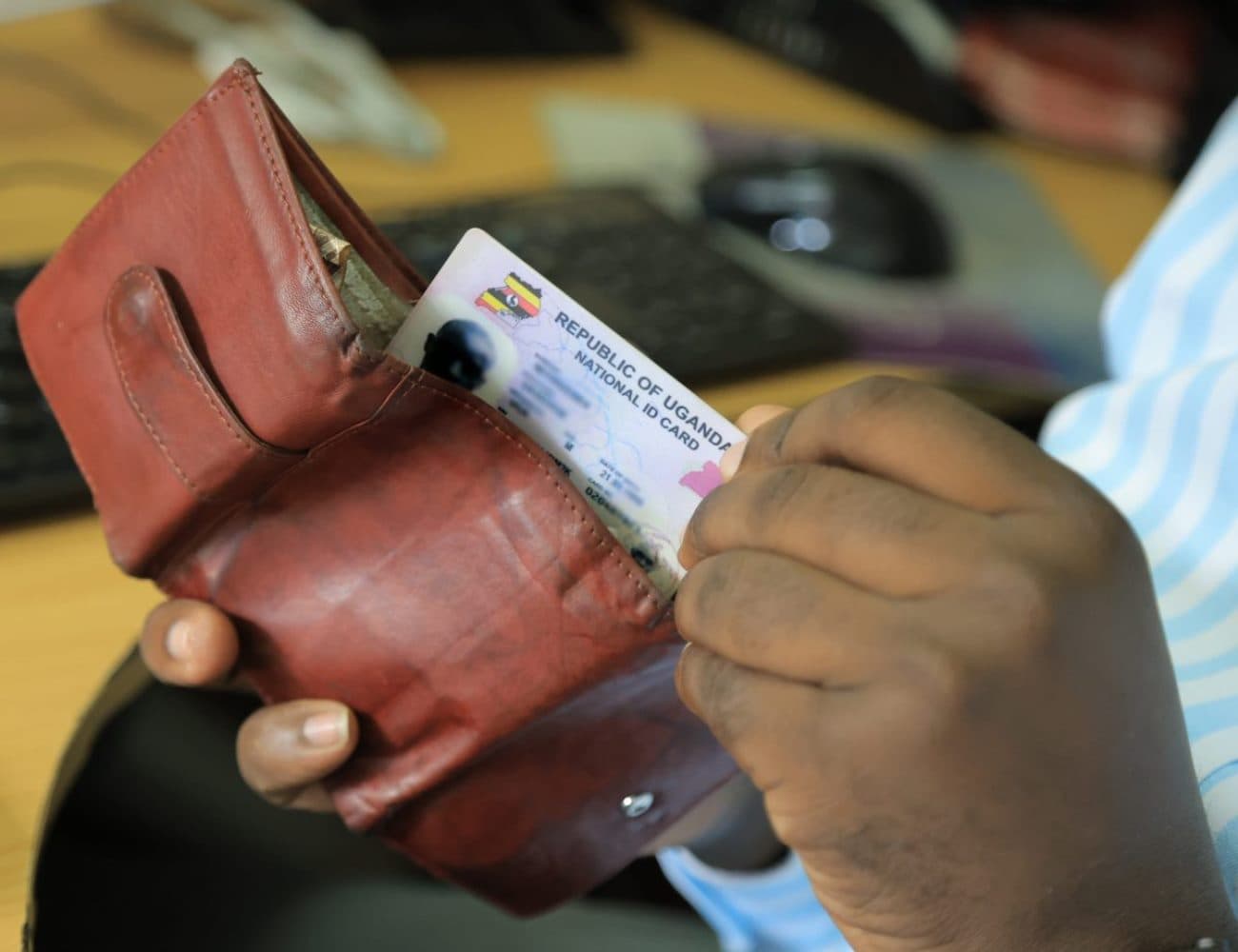
Uganda’s National Digital ID (NID) has changed lives, enabling many people to thrive because they can easily access services.
“In my day-to-day work, I use my National ID to carry out financial transactions in the bank. Without it, I can’t access funds,” Stella Nakazibwe, a SACCO administrator, is quoted in a study conducted by Makerere University researchers. “Now, I also use it to register for my school. You can’t sit for ICPAU papers without registering, and a National ID is essential.”
Launched in 2014, Uganda’s National ID system aims to streamline services, boost security, and promote financial inclusion. A recent study shows 97 percent of Ugandans view it as vital. The system, managed by the National Identification and Registration Authority (NIRA), requires all citizens aged 16 and above to hold an ID linked to their biometric and demographic data. Mass registration campaigns and SIM card requirements have driven its adoption, with telecom companies relying heavily on the ID database.
The study, “Understanding the Benefits, Costs, and Challenges of the National Identification System in Uganda,” published in Digital Society, highlights both successes and hurdles. Led by Roy William Mayega from Makerere University’s Resilient Africa Network, the research surveyed nearly 3,000 Ugandans. Other researchers included Dr. Dorothy Okello, Christine Muhumuza, Nathan Tumuhamye, Julius Ssentongo, Dr. Allen Kabagenyi Mulerwa, Brandon Kwesiga, Dr. Agnes Nyabigambo, Anthony Ssebagereka, and Professor William Bazeyo.
The study reveals the NID system delivers strong returns, with every US$1 invested yielding US$1.35 in savings through reduced fraud and better public fund management. For many, like Nakazibwe, the ID unlocks access to mobile money, bank accounts, and the formal economy.
However, challenges persist. While 94 percent of Ugandans tried to register, nearly one in five still lack an ID. The poorest face the biggest barriers, with Mayega noting, “Reasons for not having a National ID were more prevalent in the lowest wealth quintile.” Issues include incomplete registration (33.7 percent), not registering (21.2 percent), lost IDs (19.9 percent), uncollected IDs (9.4 percent), and slow processing (7.7 percent). Women often cite long queues and costs, while rural residents mention limited registration time.
Data privacy concerns also loom large, with fears of surveillance and fraud. Common ID errors include misspelled names (45.0 percent), incorrect birth dates (16.6 percent), unclear fingerprints (8.9 percent), and improper signatures (3.6 percent). Only 28.5 percent of those with errors tried to fix them, with just a third succeeding after an average six-month wait. Most found the process difficult, facing costs up to 525,000 shillings (US$145.8).
To address these issues, researchers urge targeted registration drives, simpler processes, stronger data protection, and wider ID use in government programs. Gilbert Sendugwa, Executive Director of the Africa Freedom of Information Centre, says, “The government must do more to teach people to protect their IDs and reassure them that their data is used to empower, not control, them.”
Without IDs, vulnerable groups like the elderly and disabled struggle to access grants, healthcare, land titles, and other services, warns the Collaboration on International ICT for East and Southern Africa (CIPESA). Digital rights advocate Juliet Nanfuka adds, “Uganda’s digital ID system needs to ensure safeguards for both data protection and access to essential services; otherwise, it risks entrenching exclusion and inequality.”
As NIRA gears up for a mass ID renewal campaign on May 27, 2025, new IDs will feature advanced security like QR codes and Machine-Readable Zones.