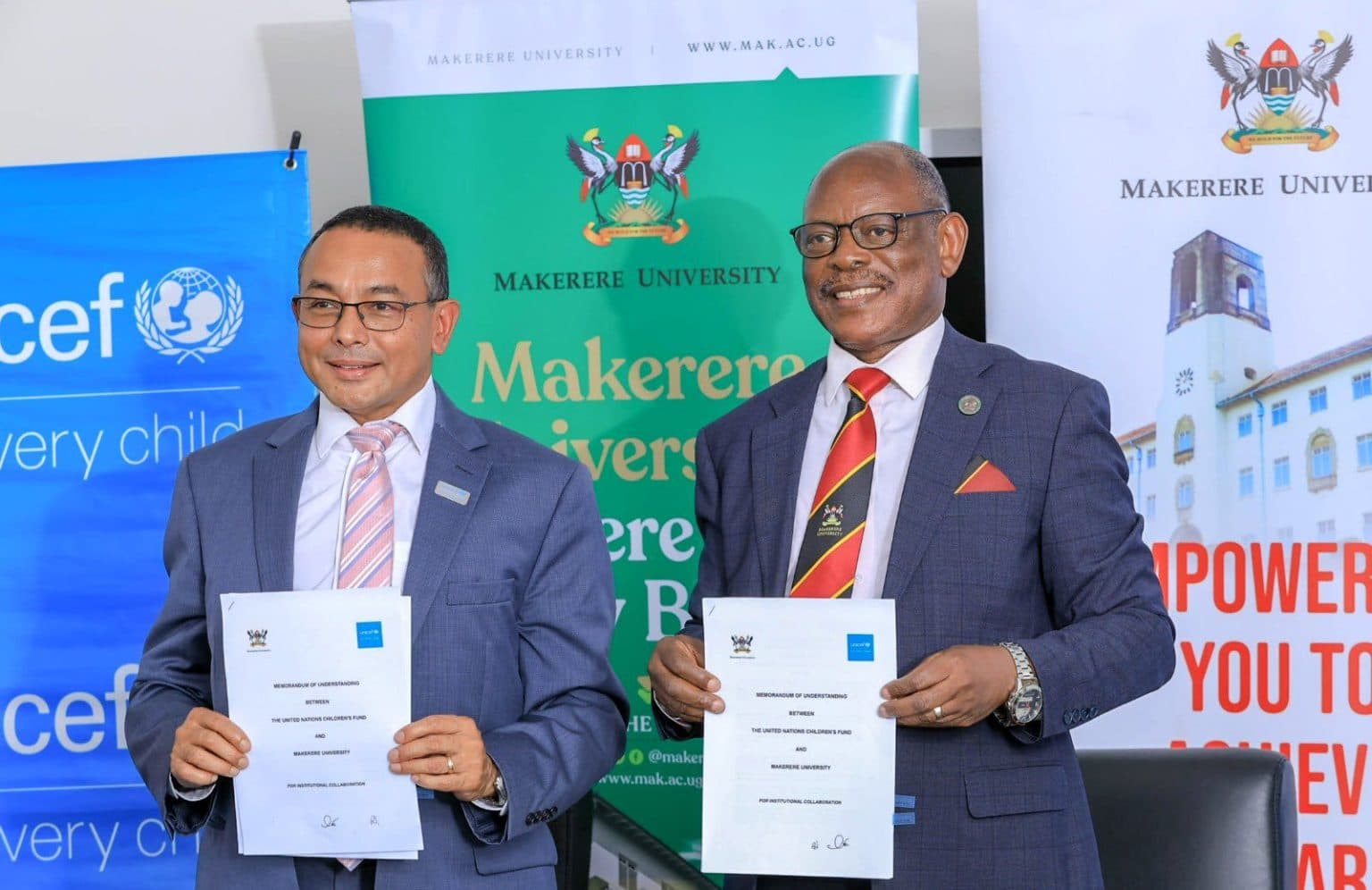
Makerere University (Mak) and United Nations Children’s Fund (UNICEF) Uganda have signed a Memorandum of Understanding launching a two-year renewable partnership to advance child rights and well-being through research, capacity building, and policy-driven innovation.
The agreement was signed on August 14, 2025, by Makerere Vice Chancellor Professor Barnabas Nawangwe and UNICEF Uganda Representative Dr Robin Nandy in the Vice Chancellor’s Boardroom at Makerere’s Main Building.
The MoU focuses on generating child-focused data and research to inform policy and programme design, analysing how health, nutrition, education, and protection initiatives affect children, and strengthening the social sector workforce through training, curricula, and performance standards.
It also emphasises knowledge management, wide dissemination of findings, policy and legislative advocacy for child rights, and student engagement through internships, skilling opportunities, and communities of practice. The renewed partnership aims to bolster evidence-based policymaking and drive programme improvements that support Uganda’s progress toward the Sustainable Development Goals by 2030.
“The signing of this MoU deepens Makerere’s long-standing commitment to Uganda’s children and Africa’s future,” said Vice Chancellor Nawangwe. “I thank Dr Nandy for his leadership and for the collaboration that will expand our capacity to deliver research with practical benefits for communities.”
UNICEF’s Dr Nandy said the partnership reflects UNICEF’s global mission to protect and promote child rights while translating research into policy and action. He highlighted Makerere’s research leadership as a key asset in generating robust evidence for government decision-making and resource allocation.
“This partnership shows our commitment to combine academic knowledge with practical results,” said Dr Nandy. “We will use Makerere’s research skills to generate strong evidence on child welfare issues, ensuring every project is based on solid data and safeguards children’s rights.”
The partnership builds on Makerere’s research strengths and UNICEF’s global mandate to protect children. It complements work through the School of Public Health (MakSPH) and other faculties, reinforcing a university-wide commitment to evidence-based policy and community impact.
Since 2016, Makerere has participated in more than 30 UNICEF-supported research projects, reflecting mutual trust and shared mission. The Vice Chancellor noted that this history laid a strong foundation for the new MoU and opened opportunities beyond the health sector.
Among earlier initiatives was MakSPH’s joint work with UBOS and UNICEF, funded by the EU, on the first comprehensive Food Security and Nutrition Assessment in 10 districts of Northern Uganda and West Nile (2019). The findings informed nutrition programmes and policies to combat malnutrition among vulnerable populations.
In 2023, MakSPH, in partnership with the National Planning Authority, UNICEF, FHI360, and the Ministry of Health, produced an updated Situation Analysis of Newborn Health in Uganda. This document guided the ministry’s national strategy, including costed investments to improve newborn health.
Professor Rhoda Wanyenze, Dean of MakSPH, hailed the partnership as a continuation of long-standing collaboration. She noted UNICEF’s support was instrumental in establishing the Makerere University Centre of Excellence for Maternal, Newborn and Child Health (MNCH) in 2013.
“It’s such a delight to formalise our partnership with UNICEF. We have worked together for decades, driving critical research and informing national policies,” she said. She stressed their shared passion for tackling adolescent health challenges, particularly early pregnancies and marriages.
The MoU extends collaboration beyond MakSPH. The Vice Chancellor noted partnerships with the Department of Journalism and Communication and the College of Humanities and Social Sciences, stressing how diverse disciplines contribute to evidence-based policy and well-being.
Another example is the Caring for the Caregiver (CFC) intervention led by the Makerere Institute of Teacher Education and Research (MITER) in the College of Education and External Studies, with UNICEF and the Ministry of Health. The evaluation assessed caregiver well-being and parenting stress in rural Uganda, adding evidence for nurturing care in resource-limited settings.
Also, the School of Statistics and Planning in the College of Business and Management Sciences worked with UNICEF on the Socio-economic Impact Assessment of the 2022 Ebola outbreak in Mubende and Kassanda. The study examined household shocks, coping strategies, and livelihood disruptions, informing national policy dialogue on preparedness.
According to the Vice Chancellor, UNICEF partnerships drive research, innovation, and outreach that benefit children and families across Uganda.
Dr Nandy said the collaboration would also support student involvement in operational work, creating pathways for young scholars to contribute to child welfare.
Both parties expressed a shared vision of translating research into concrete actions to strengthen child protection and expand opportunities for learning and development. The collaboration is expected to generate effective interventions, sharpen policy dialogue, and catalyse scalable innovations that improve children’s lives in Uganda.